

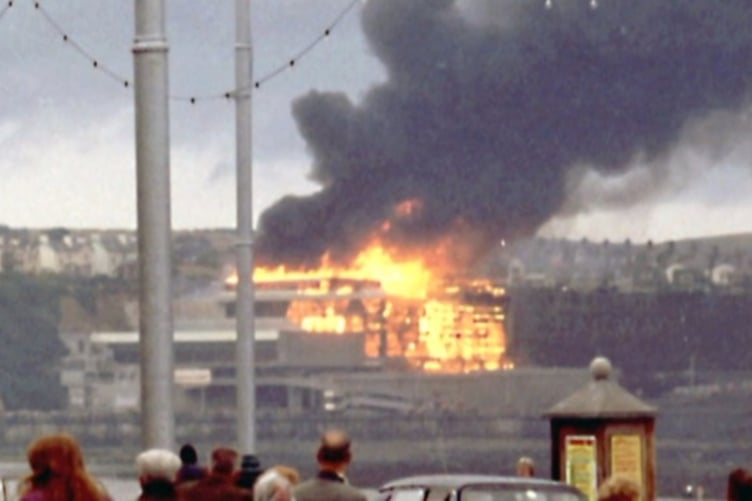
A minute’s silence was held in the high court as families of victims and survivors began their legal challenge to have fresh inquests into the Summerland disaster.
Fifty people lost their lives in the blaze at the Summerland leisure centre on August 2, 1973.
In May last year, Attorney General Walter Wannenburgh rejected an application made by Justice for Summerland campaign group, representing some of the victims and survivors, to hold fresh inquests into the deaths.

Jacqueline Hallam, who lost her best friend and mother in the fire, lodged a claim against the AG’s decision on behalf of Justice for Summerland with the case due to heard in the high court over a day and a half this week.
Opening the case for the claimants on Wednesday, advocate Steven Coren, said: ‘The verdict of misadventure has caused and continues to cause significant offence among the families and the survivors, and the relatives of the survivors.’
He said this in large part had motivated the claim ‘to try to remove the stain that innocent members of the public who were attending Summerland were in some way responsible for their own deaths’.
Mr Coren asked the court to keep in mind at all times the ‘50 victims of this terrible fire and the scale of the tragedy’.
Miss Hallam and the grand-daughter of another victim attended court for the hearing.
The court heard that inquests into all 50 victims was held as a summary process that was completed in one day.
Mr Coren read out a sample verdict which recorded a verdict of ‘misadventure when the Summerland leisure centre was destroyed by fire’.
He said the AG had accepted that the original inquest was brief and rather summary. ‘Our submission is that’s an under-statement and that an appropriate level of detail was not gleaned,’ he said.
Justice for Summerland’s campaign has been energised by the overturning of a verdict into another fire tragedy - the blaze at the Stardust ballroom in Dublin in 1981 in which 48 people attending a Valentine’s Day disco lost their lives.
The original inquest ruled the Stardust fire started because of arson. Further investigations found the fire was caused by an electrical fault. Following a campaign by victims’ families, a new inquest was held with the jury recording a verdict of unlawful killing in 2024.
Mr Coren described Stardust as an ‘exemplar’ and said it was ‘inevitable’ that a fresh inquest into Summerland would have a different outcome.
He said there had been technological advances in forensic fire investigation that would not have been available in the 1970s and were leading to different outcomes, and cited a leading expert who was involved in the Grenfell fire inquiry who is supporting a fresh inquest into Summerland.
Mr Coren also highlighted shortcomings in the original Commission report.
He said an approach ran throughout the report that did not reference lives, giving as an example a line in it about an attempt being made by those present to extinguish the fire and if the fire brigade had been summoned then, the building might have been saved.
And he said the report, on which the inquest relied, ‘condescends’ to state the location of death of only 28 of the 50 who died. ‘Who died where? We are not told by the Commission at all,’ he said.
Oliver Helfrich, representing the AG’s chambers, said that a retrospective claim would not be successful given the time that had elapsed.
He said there was nothing to suggest that after 52 years a fresh inquest would provide new information on how, when and when victims died.
And he submitted court that for every one who believed a reopened inquest would heal there would be two or three others who would feel that wouldn’t be the case.
Deemster Andrew Corlett said the original inquest had failed to give individual verdicts which he said ‘today is really not acceptable’.
He will hand down judgment at a later date.