
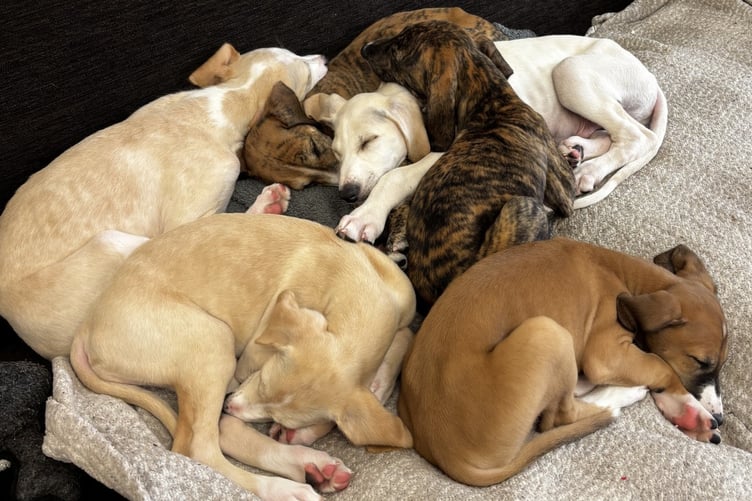
The MSPCA kennels in Foxdale doesn’t have puppies for rehoming very often, but the team were very excited about the arrival recently of not one but six adorable eight-week-old lurchers.
A couple of the pups had umbilical hernias which have now been treated by a vet, but other than that all of them are fit and well. And very, very active!
Lurchers are a mixed breed that combines traits from sighthounds (think greyhounds, salukis and whippets – all of which have excellent eyesight to aid their hunting) with those of other working breeds such as border collies or terriers.
They can vary enormously in size, shape and personality, but they invariably have a very strong prey drive, high energy and intelligence.

.jpeg?width=209&height=140&crop=209:145,smart&quality=75)
Our six puppies will grow to be medium-sized, slim, short-haired dogs and bitches, and some are a light beige colour whilst others are brindle and brown.
We have already found homes for three of the pups and it won’t be too long before the remaining three are heading off to live with their ‘forever families’.
The new owners will all need to be committed to socialising their respective pups from day one. They will need to be gradually introduced to the sights, sounds, people, places and other animals that will be part of their future world.
The pups are all at a key stage of development: up until the age of about 14 weeks they will be at their most receptive to new, low-stress experiences.
Socialisation should be carefully planned and involve a variety of scenarios: people (adults, children, people with hats or glasses, people in wheelchairs, etc.); animals (friendly dogs, cats, and other species when it is safe and appropriate); environments (parks, car journeys, walking on a pavement, visits to the vets, etc.); sounds (doorbells, household appliances, traffic, etc.); and gentle handling at all times.
Interactions during socialization must be carefully managed to make sure a puppy’s experiences are positive, and pairing these with a tasty treat is an easy way to create a positive association. Each interaction should give a puppy the choice to either engage or avoid, letting them approach or retreat at their own pace.
‘Flooding’ is a term used to describe when a dog is forced to face something scary that is overwhelming, and this can lead to the animal shutting down and becoming even more afraid.
Being around well-mannered, calm, friendly, older dogs is a great way for a puppy to learn healthy body language and how to interact with other dogs.
Well-run puppy classes are another fantastic way to give a puppy a good start in life, and these should be started when a pup is between eight and twelve weeks’ old. They give a puppy a safe, controlled space in which to play, learn and practice good manners.
After about twelve weeks, most puppies become less social; and by about twenty weeks socialisation is much harder and may not work with some dogs.
Missing the early window of opportunity can lead to lifelong behavioural issues that are difficult, sometimes impossible, to fix. One of the worst of these is a dog that reacts badly to other dogs, making walks stressful for all concerned.
Our lurcher puppies will need to return to Ard Jerkyll for their second vaccinations, and in about 12 months they will return for spaying and neutering – a requirement of the adoption process, and funded by the MSPCA.
These energetic bundles of fun will provide many years of rewarding dog ownership to their respective families, but we are reluctant to rehome them where there are cats already in situ given their prey drive might be just a bit too strong to overcome temptation!