

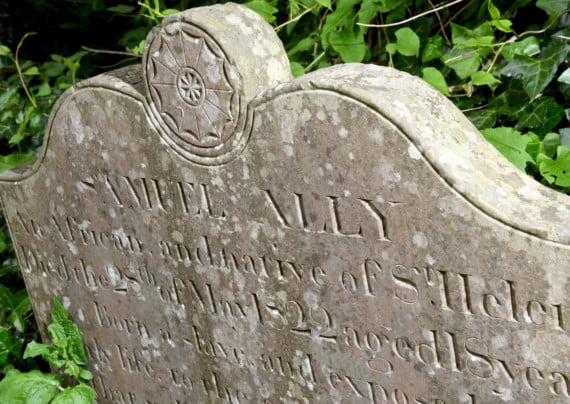
The moving story of a man who was born into slavery but was rescued by a Manxman who brought him to the island should never be forgotten.
Samuel Ally was born into slavery but was granted freedom by his master, Kirk Michael-born Colonel Mark Wilks, the governor of St Helena at the time of Napoleon’s exile there.
Colonel Wilks later returned to the Isle of Man, bringing Samuel Ally with him.
When Samuel died at the age of 18 he was buried at Old Kirk Braddan Church in 1822 in a grave with a headstone paid for by his employer Colonel Wilks.

-and-Tim-Foster-(right)-out-on-the-Atlantic-Ocean.png?width=209&height=140&crop=209:145,smart&quality=75)
.jpeg?width=209&height=140&crop=209:145,smart&quality=75)
The story has now been taken up again by a leading figure in St Helena, a British Overseas Territory in the South Atlantic, close to the islands of Ascension and Tristan Da Cunha.
Stedson Francis BEM (British Empire Medal), a member of the St Helena ruling council, has written to the clerk of Tynwald Roger Phillips in a bid to ensure that Samuel’s grave is given regular attention.
Mr Francis fondly recalls his visits to the Isle of Man and in particular the connection between the island of St Helena and the Isle of Man, represented by Governor Mark Wilks and Samuel Ally.
Mr Francis writes: ’My first visit to the Isle of Man was in 1990 training with the MEA Manx Electricity Authority. It was 20 years later in 2010 when I represented St Helena at the British Islands and Mediterranean Regional Conference that I first became aware that there was a St Helenian connection with the Isle of Man.
’One of the Isle of Man councillors asked me if was I aware that a St Helenian was buried in one of the island’s cemeteries. Governor Wilks who was a Manxman was Governor of St Helena from June 21, 1813 up until just before Napoleon’s arrival in October 1815. Hudson Lowe took over as Governor of St Helena.
’When Wilks returned to the Isle of Man he took his St Helenian manservant back with him, one Samuel Ally. Sam died at the age of just 18 years.
’One of the Isle of Man members (former speaker Steve Rodan) took me to see his grave and I understand that for many years the Girl Guides used to place flowers on his grave on the anniversary of his death.
’This does not happen anymore and it would therefore be appropriate if some arrangement could be made from the island or the next time someone or a group visits to see if this grave could be given some regular attention.’
The gravestone inscription says: ’An African and native of St Helena. Died the 28th of May 1822 aged 18 years. Born a slave, and exposed to the corrupt influences of that unhappy state, he became a model of truth and probity for the more fortunate of any country or condition.
Clerk of Tynwald Mr Phillips, who is preparing to retire from the post later this year, said the island was due to host another British Island and Mediterranean Region conference in the next few years and the story of Samuel Ally and Governor Wilks was significant.
Mr Phillips said it was important to maintain close links with islands such as St Helena which has in recent years become easier to having built an airport
A review was launched last year to establish which Manx church monuments and tombstones have links to the slave trade.
The audit of memorials in Church of England grounds was launched by Right Reverend Peter Eagles.
The church should ’acknowledge’ any ’deep injustice and human sadness’ associated with the memorials, the Lord Bishop of Sodor and Man said.
The audit is considering more than 40 buildings and churchyards.
Comments
This article has no comments yet. Be the first to leave a comment.