

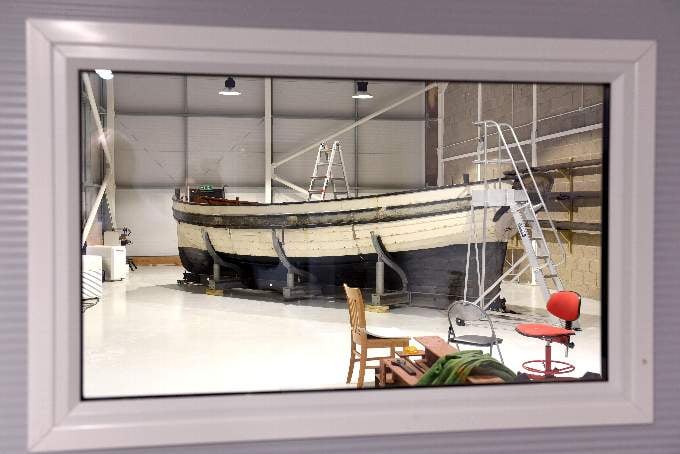
Fundraising is under way to move an historic schooner into a purpose-built home in Castletown.
Manx National Heritage is leading a campaign to find £2.5m to move the 1789 Peggy and rehouse her. Another £2.5m will be requested from government as a capital bid.
MNH wants to house the vessel in a dry dock outside the Nautical Museum in Castletown and surround it in an enclosure.
The costs are based on the concept designs, which were calculated using assessments by a cost consultant and recent ’actual’ exhibition design costs.

.png?width=209&height=140&crop=209:145,smart&quality=75)
.png?width=209&height=140&crop=209:145,smart&quality=75)
.jpeg?width=209&height=140&crop=209:145,smart&quality=75)
MNH says market testing will be undertaken when full design details have been agreed and the whole project cost is secured.
In 2015 the schooner was moved from Castletown’s Nautical Museum’s cellar, where it was being damaged by seawater, for safe storage in an industrial unit in Braddan.
The issue has led to many letters to our newspapers in the last couple of years.
The Peggy is the last intact surviving shallop and oldest surviving schooner in the world. She is also the oldest surviving vessel to have been fitted with sliding keels.
The vessel is one of 200 to be listed in the National Historic Fleet in the UK.
An MNH spokesman said: ’The vision for the site is ambitious but wholly appropriate if the Peggy is to be accommodated in a way that is suitable to maintain her in stable conditions and tell the story of the Peggy, her owner George Quayle, and 18th century Isle of Man in a way that marks it out as a world-class heritage visitor attraction adding significant value to the wider visitor economy and contributing to Exchequer benefit [tax money] for the government.’
The budget cost includes the design, construction and development of the new boathouse for the Peggy at the Nautical Museum, together with the costs to conserve and re-display the registered buildings, Quayle’s private dock and introduce what MNH say will be a ’modern and engaging experience for all as part of the Nautical Museum Heritage visitor attraction’.
George Quayle was a prominent member of Manx society and was involved in commerce and politics.
How does the £5m compare to other projects?
l The Newport Ship, Newport, Wales was reported in 2014 as requiring a minimum of £4m just to display the remains of the ship in a simple industrial building.
l In 2016 a £5m makeover of the Mary Rose museum in Portsmouth was completed. This was in addition to previous £39m spent on conserving and displaying her.
l Preservation and restoration of the SS Great Britain, the first iron screw propelled ocean going ship and her dry dock to include visitor facilities was completed in 2005 at a cost of £9.5m
l The National Maritime Museum, Cornwall was completed in 2003 at a cost of £21.5m.
l The Cutty Sark, the world’s last surviving tea clipper, was devastated by fire in May 2007 and a £50 million restoration project was completed in 2012.
Comments
This article has no comments yet. Be the first to leave a comment.