
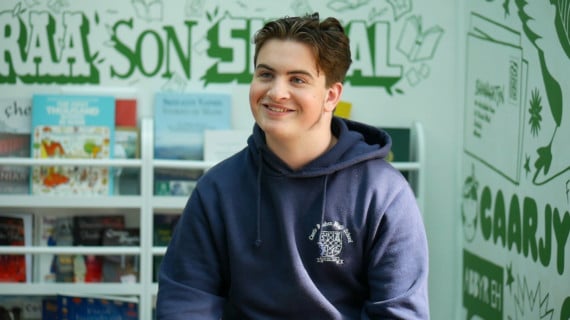
For me, Manx has been around throughout my life in one form or another. My mother learnt Manx when she moved to the island from Limerick, and when I was born, she would use phrases and speak to me and my sister when we were both very young.
I also attended Mooinjey Veggey until I was old enough to go to school.
Unfortunately, as I grew up I lost most of the Manx that I had gained.
My parents became very busy and often didn’t have the time to talk Manx with me and I suppose it just gradually stopped.


.jpeg?width=209&height=140&crop=209:145,smart&quality=75)

This remained the case until I was 13 years old, when on the annual trip to Ireland to see family, I heard two men conversing in Irish.
They were just having a casual chat, but I was shocked by the fact that they were speaking such a distinctive language. It also struck me that back home on island we had our own language too, and I remember how important I felt speaking Manx was at that moment.
That summer, I began to re-learn Manx by speaking what I remembered with my family and taking part in the Bree summer workshop, in addition to starting school lessons that September at the start of year nine.
I gradually built up my vocabulary and spoke the language as much as I could with as many people as I could, until speaking Manx became natural.
To my surprise, as I acquired more knowledge of Manx, other languages immediately became easier to speak, such as French (which had never been the easiest of subjects for me) and I met a lot of good friends, adding to the long list of benefits to Manx learning.
I’m now sixteen, and the ability to speak Manx has given me a whole plethora of opportunities.
I’ve gained a GCSE and A-Level equivalent in the language, I’ve met a huge number of new people I’m now very good friends with, and I have been doing some work for Culture Vannin during the summer which I loved doing.
There are so many opportunities for help and support through the learning process.
Websites such as LearnManx.com and Taggloo provide quick and easy ways to practice or learn new vocabulary or search up a word you’re not familiar with, and there is also the island-wide community who are always willing to help you and have a conversation to practice.
I couldn’t recommend learning Manx more.
It’s a fantastic way to connect to the past and present of the island as well as the future and it’s such a satisfying experience to speak in the language of where you live, whether you’re a Manx native or you’ve come over from another country.
If I ever have children, I’ll raise them so that they grow up bilingual in our native language as well as the international language of English.
English is obviously a great tool to have, just like Mandarin or Russian, but those are languages can be learned at any time and are unlikely to be needed much in Ellan Vannin.
Manx however, is linked very strongly to ourselves and to the land we live in, and I strongly believe that it’s a very worthwhile and important part of our culture and identity which everyone should be welcome to take part in.
It opens many, many doors, giving you an increased sense of identity and a different view of the Island, also allowing you to appreciate the history and landscape of the Isle of Man, and you will no doubt make many new connections.
Cheer gyn chengey, cheer gyn ennym-a country with no language, a country with no identity.
by Owen Williams
twitter:@iomnewspapers
Comments
This article has no comments yet. Be the first to leave a comment.