

At first glance, 42-year-old Kim Cowell looks like many others you might pass in the street.
But what most people never see is the reality behind closed doors, where entire days can disappear without warning.
‘I might look fine. I’m not fine,’ she said. ‘People don’t know that I’ve been sat in a chair catatonic for six hours.’
Catatonia is a serious mental health condition that can cause people to become unresponsive, immobile or unable to speak for prolonged periods.


.jpeg?width=209&height=140&crop=209:145,smart&quality=75)

Kim lives with a combination of severe mental health conditions, including catatonia, bipolar disorder, schizophrenia, PTSD and anxiety.
She is one of only a small number of people on the Isle of Man diagnosed with the condition at this level of complexity.
‘There’s only 12 of us on the island that suffer with the severity of the condition that I’ve got,’ she explained.
And she says catatonia dominates her daily life.
‘Literally every day, I will go catatonic multiple times a day, and I can’t function day to day,’ Cowell said.
She described the experience in simple terms: ‘It’s like when you overheat a laptop and it says shut down… that’s what my body’s doing.’
Despite the severity of her illness, Cowell says much of what she goes through remains invisible.
‘People think if you don’t tell everybody business on Facebook, it’s not happening,’ she said.
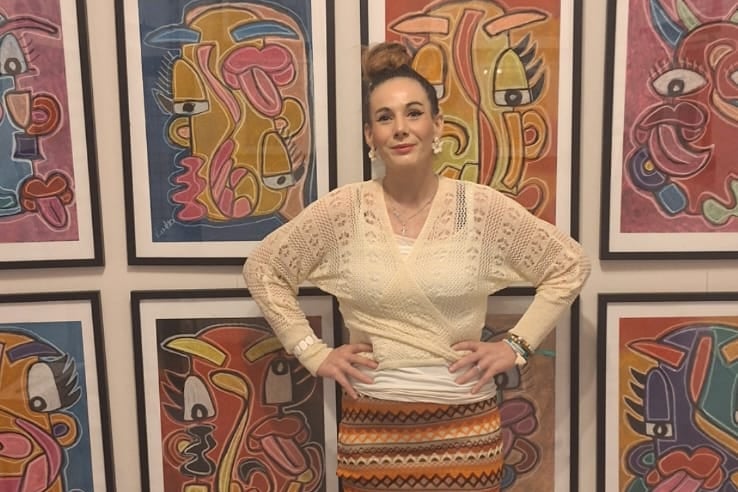
She believes misunderstanding fuels stigma, and says the stigma surrounding serious mental illness can be as damaging as the illness itself.
‘I am sick and tired of people stigmatising people for being mentally unwell,’ she said. ‘There are people that suffer very serious mental health conditions.’
At home, Cowell relies heavily on her partner Tim, who became her full-time carer following a nervous breakdown two and a half years ago.
‘It’s not a part-time job, it’s a full-time job,’ she said. ‘If he wasn’t my stay-at-home carer, I would have to be in a facility.’
‘It’s more therapeutic than the medication,’ she said. ‘If I’m having a panic attack and I go out and start drawing, I calm down straight away.’
She added: ‘When I’m painting, my mind quiets down. It’s like all the chaos has somewhere to go – onto the canvas.’
Earlier this year, Cowell held her first art exhibition, selling six pieces and raising £725 for the Samaritans. She donated all proceeds apart from the gallery’s commission.
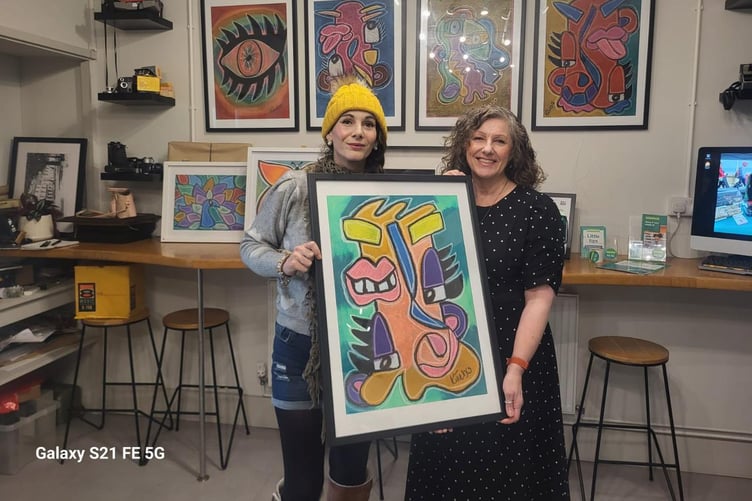
‘They’ve supported me for the last two and a half years,’ she said. ‘Sometimes I just need someone to talk to.’
‘They’ve always been empathetic and patient. Just knowing someone will listen without judgement has kept me going.’
While proud of the exhibition, Cowell said it took a toll on her health, with long days leaving her exhausted.
‘I can only do what my body allows me to do,’ she said. ‘I try and push myself, but I can’t fight it.’
Kim says she speaks publicly to raise awareness and challenge stigma.
‘Just because you can’t see it,’ she said, ‘doesn’t mean it’s not happening.’