
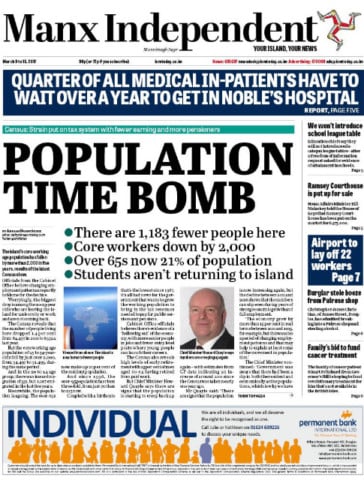
The island’s population appears to be bouncing back - and is now growing at about 400 a year.
It emerged in the last census that the core working age population had fallen by 2,000 over five years, with the biggest drop being among 20-somethings who were leaving the island for university or work and not coming back.
Between 2011 and 2016, the number of people living here dropped by 1.4 per cent from 84,497 to 83,314.
It was bad news for the government that needs the population to grow to bring in the tax revenues to pay for public services and pensions.
.jpeg?width=209&height=140&crop=209:145,smart&quality=75)



But the latest quarterly economic report for the Council of Ministers shows that downward trend has reversed.
It estimates that the total population is now 370 up year on year, the second consecutive quarter which has seen a sizeable increase.
The growth in under 65s is up 115 year on year and both increases are accelerating.
Chief Minister Howard Quayle said: ’We are back on track.
’The population has gone up for a second quarter.
’The last quarterly report showed growth of 300 a year and now that’s gone up to 400.
’And as there are more deaths than births, the figure is probably nearly 500.
’At the time of the census we had an idea we had been losing people but now for the second quarter we have growth.’
Mr Quayle said there were an number of reasons for the turn-around but cited as one the relaxation of work permit requirements for ICT engineers.
He said: ’These are areas where businesses are desperately looking to expand.
’In October- November, the Department of Economic Development is going out for a review of work permits to see what else we can do to improve the situation. We are not going to do away with the work permit system but we need to ensure it is as efficient as possible.
’We are down to 1% unemployment which, while a fantastic achievement, is a concern for businesses who want to expand but do not have the staff to fulfil those contracts.’
Unemployment remains at a 13-year-low of about 400.
But the quarterly report says the housing market remains subdued when it would normally be expected to increase at a time of growth in inward migration.
It states there could be two causes for this.
Firsly, uncertainty over Brexit is affecting large scale decision-making, with those moving to the island or trading up being more reluctant to invest.
Secondly, as new houses continued to be built during the period of population decline, prices may now remain flat despite underlying population growth.
The report reveals that DED has submitted a major application for support for an existing engineering company wishing to build a replacement factory which will be about 30% larger than its current site.
Talks have also progressed with two other existing engineering companies who want to expand and the report says there had been a high number of inquiries to the DED’s £50m Enterprise Development Scheme, financial assistance scheme and business support schemes.
The last quarter also saw 48 new e-business jobs filled.
Comments
This article has no comments yet. Be the first to leave a comment.