
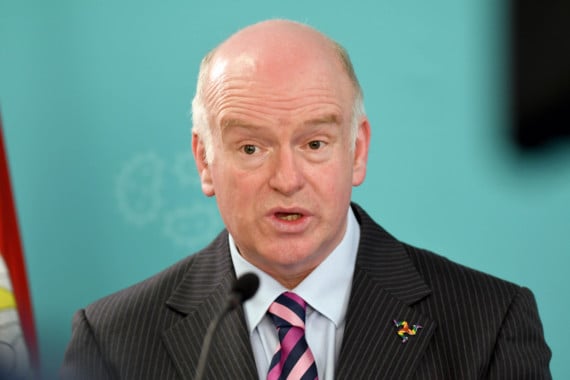
Plans to further ease border restrictions have been put on hold following the final Tynwald sitting before the general election this week.
The proposed changes included:
*OPENING up travel from countries on England’s green and amber lists
*EXEMPTING children aged 11 and under from testing and isolation

.jpeg?width=209&height=140&crop=209:145,smart&quality=75)
*RECOGNISING additional vaccines that have received regulatory approval, which would open up unrestricted travel to the Isle of Man for many people in Ireland
*REMOVING exit tests for those who are in isolation because of the virus.
At the Covid-19 briefing held yesterday Chief Minister Howard Quayle said: ’It is still our intention to return to unrestricted travel between the Isle of Man and the rest of the British Isles, in line with our Covid-19 Exit Framework.
’We had hoped the next step on that journey could have been this Saturday.
’Regrettably, Tynwald voted not to allow standing orders to be suspended so that the supplementary order paper that contained these regulations could be taken.
’Clearly the Council of Ministers felt these changes were important to consider, as did the majority of Tynwald Members, and it is disappointing a minority did not feel Tynwald should even discuss them today.’
He explained that he was yet to discuss the repercussions of this decision with the Council of Ministers, but would do so following the Covid-19 briefing.
He added: ’For now, it means the regulations will not be voted on and none of the changes will come into effect on Saturday as we had hoped.’
Mr Quayle and the Health Minister David Ashford also addressed widespread criticism of the current government approach to the pandemic, given the recent increase in coronavirus cases in the island.
Mr Quayle said: ’I fully appreciate this change in mind-set will take time. After doing all we could to keep the virus from our shores for so many months - including three lockdowns - it is jarring to see the virus spreading, with no restrictions in place.
’After all we have been through together in the past year and a half, this shift - from eliminating the virus, to putting in place mitigations and learning to live with it - was never going to be easy.’
When asked if the government had a clear projection in numbers for the current ’wave’ of cases, or a projected date for the peak of the wave, the Health Minister explained that the recent rise in numbers may be due to the high level of community uptake in home testing via lateral flow devices (LFDs), adding that: ’What matters is not the case numbers, it’s the outcome of those cases.’
The lack of LFDs currently available on island was flagged as an issue in the briefing and it was acknowledged that the island’s full initial supply of 40,000 packs have been collected by residents, with pharmacies playing a major role in their distribution.
It was announced yesterday that a further 120,000 lateral flow home tests kits will be made available to the general public next week, at an estimated cost to the taxpayer of £2.75 per test.
Both the Chief Minister and the Health Minister insisted the cost for this testing would be worth it, as it is helping to keep track of cases as the island continues to move into the mitigation phase of the pandemic response.
The percentage of the eligible population who are currently vaccinated with at least one dose is almost 90%
Mr Quayle said: ’And the number of people who have received their second dose grows each and every day. As of Tuesday this week, over 77% of those eligible for a Covid-19 vaccine had received both doses, a number which increases with each passing day.
’We hope that, by August 31, all eligible adults on the island will have been offered the opportunity for their second dose.’
Walk-in vaccine clinics will be available for those aged over 18 at the Chester Street vaccination hub on Tuesday and Wednesday next week on a first-come-first-serve basis.
This followed the news this week that the Isle of Man government will follow guidance published on Monday (July 19) by the Joint Committee on Vaccination and Immunisation which advises UK health departments on immunisation.
The new JCVI advice allows for children and young people aged 12 years and over with specific underlying health conditions that put them at risk of serious Covid-19, children and young people aged 12 years and over who are household contacts of persons (adults or children) who are immunosuppressed, and some 17-year-olds to be offered the Pfizer vaccine.
Mr Ashford told Tynwald that the government was putting the mechanisms in place to be enable this rollout.
Comments
This article has no comments yet. Be the first to leave a comment.