
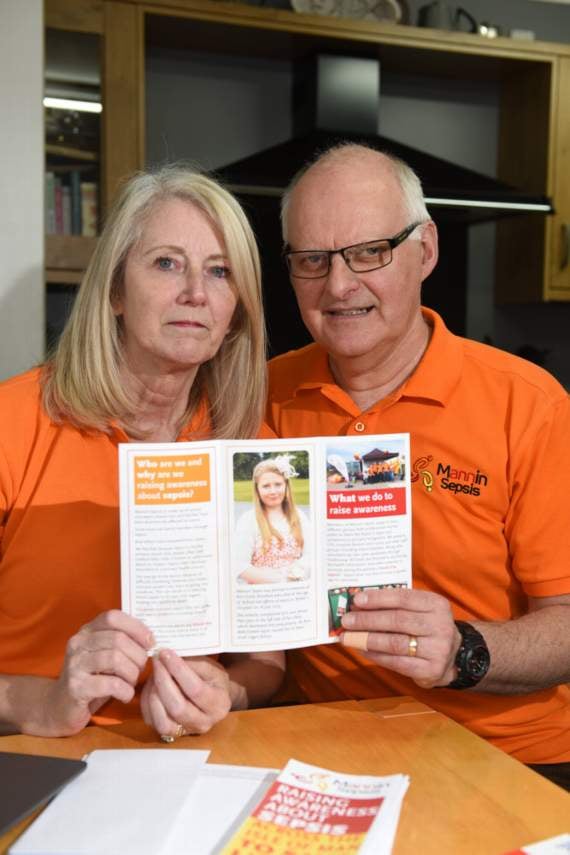
If the public don’t know the signs and symptoms, and don’t know which questions to ask, we’re going to lose more lives, says Dee Struthers.
Dee should know. In 2013, she lost her 18-year-old daughter, Ann, to the disease.
Before having her own children, Dee had worked on a children’s ward for six years and her husband John was manager of Keyll Daree, where he trained student nurses. Yet when Ann became ill they had no idea of the symptoms that could indicate sepsis.
’We had never heard of sepsis, either of us,’ Dee says.



.jpeg?width=209&height=140&crop=209:145,smart&quality=75)
Much has changed in the five years since then. On the island it has been Dee, via Mannin Sepsis, the charity she founded, which has been responsible for getting the word out to as many people as possible, educating not just the general public but those in the medical profession as well about the danger signs to look out for.
Put simply, sepsis is the body’s over-reaction to an infection and it can start off, as it did in Ann’s case, looking like nothing more than the flu.
The family were going to a wedding in Scotland, which is where the last, poignant photograph of Ann was taken.
But a few days after their return, Ann was off her food and had started to complain of a pain in her left side.
Dee recalls: ’By the Friday which was Tynwald Day she burst into tears and she had a pain in her left side. Ann didn’t cry for much at all so I knew there was something wrong then.
’In the morning when we got up her colour wasn’t very good so I took her pulse and it was 130 and her breathing was very fast and very shallow.
’But when I took her temperature I thought for a moment it wasn’t working because her temperature was low. We’ve since found out that that is part of what sepsis can be: it doesn’t have to be a high temperature.’
On an initial visit to A&E Ann was prescribed painkillers and sent home. Overnight her condition deteriorated and Dee found herself on her laptop, looking up signs and symptoms at 3am and realising that Ann probably had pneumonia.
They returned to A&E the following morning. Dee says: ’Sepsis was not mentioned to us at that point at all. It was just confirmed that it was pneumonia and they gave her morphine but she was becoming sick and it was just progressively getting worse.
’They admitted her and the day after I noticed that her hands were starting to swell.
’I asked the doctor what was causing that and he said: "Well, she’s on the sepsis pathway", and I thought: "I don’t even know what that is".’
Despite treatment including a chest drain for pleural effusion, which drained 1,000mls of fluid from one of Ann’s lungs, her condition continued to deteriorate: a few days later she was moved into intensive care and from then on either John or Dee was with her all the time.
It was decided that Ann would have to be intubated and the doctor told her that they were going to put her to sleep to do this.
Dee recalls: ’Ann freaked out, thinking of her dog who had also been "put to sleep". A student nurse came to the rescue by suggesting that Ann should open all her get well cards and presents before the procedure.
’The nurse said: "They will be the first thing that you see when you wake up afterwards".’
Tragically, Ann never woke up. ’We lost her on July 18, 2013,’ says Dee.
Looking back now, with the knowledge she has acquired since, Dee is left reflecting on the number of opportunities that were missed by doctors to spot what was going on with Ann early enough for it to be treated effectively.
In the UK, 260,000 people will get sepsis each year and 44,000 will die from it. The difference between those who survive and those who do not is often an early diagnosis, which makes it crucial that doctors spot the signs quickly.
Dee says: ’There’s nothing we can say or do that will bring Ann back but that is why three years after we lost her I decided to approach UK Sepsis Trust to see what I could do.’
Initially she became a volunteer for UK Sepsis and in July 2017 she stood up to give a talk about it at the hospital.
She recalls: ’I was blown away: there was so little information. People were coming up to me saying: "Is sepsis something you get across - you don’t get it on island - do you?" or they thought that it only affects young people or the elderly.
’The doctor who had nursed Ann came and said to me: "This is what we need in this hospital".
’We found out later that the policies and procedures for sepsis had not been changed since 2008.
’The sepsis pathway has now been updated and I realise through reading Ann’s notes that the chest drain should have been done earlier.
’Instead of having anger towards that I’ve channelled my energies into getting more people surviving sepsis.’
Ali Thomas is a sepsis survivor. She developed the condition in May 2016 following routine surgery.
She recalls: ’Whilst I was recovering in hospital, I felt very strongly about turning my experience into something positive and it was when recovering at home that I discovered Ann’s story.’
It inspired Ali to join forces with Dee and together they set up Mannin Sepsis, a local charity which spends all the money it raises in the island. Ali says: ’I feel passionately about sharing mine and Ann’s stories to help save lives within our community.’
Dee says: ’Ali and went out as foot soldiers, speaking to people and getting this information out there.’
As well as doctors, nurses, dentists and other healthcare professionals they have also visited schools, speaking to children and teachers, nursing homes and corporates.
They have purchased equipment for the pathology lab at Noble’s, to help them diagnose sepsis as soon as possible and they are fundraising for more.
Dee says: ’I’d like it for everybody to be aware and less people to be losing their lives to sepsis.
’It’s unacceptable, it’s been a hidden killer for far too long, and now is the time to become more empowered, to educate ourselves to ask more about signs and symptoms. We know it can save lives.’
Sepsis arises when the body’s response to an infection injures its own tissues and organs.
In the early stages it is highly amenable to treatment through early diagnosis and timely and appropriate clinical management.
Sepsis can initially look like flu, gastroenteritis or a chest infection.
Seek medical help urgently if you develop any of the following symptoms:
â?¢ Slurred speech or confusion
â?¢ Extreme shivering or muscle pain
â?¢ Passing no urine (in a day)
â?¢ Severe breathlessness
â?¢ Skin mottled or discoloured
’Ali and went out as foot soldiers, speaking to people and getting this information out there.’
Comments
This article has no comments yet. Be the first to leave a comment.