
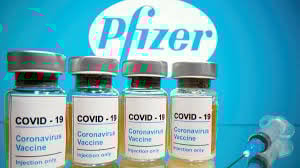
Details of the island’s biggest-ever mass vaccination programme have been outlined as the green light was given for its roll-out over the next 10 months.
Health Minister David Ashford told this week’s Covid briefing: ’Nothing quite like this has been done before.’
He described the long-awaited news that the Pfizer/BioNTech vaccine has won approval from the medicines regulator as ’a landmark’.
Mr Ashford said it was the ’green light to put in motion plans to vaccinate our community against this cruel virus, and look towards a brighter future’.



.jpeg?width=209&height=140&crop=209:145,smart&quality=75)
He said: ’The vaccine can now be shipped from the factory in Belgium to the UK. And from there, we can expect swift onward delivery of our share to us.’
The island is confirmed to receive 130,000 vaccine doses with the Pfizer one delivered in trays of 975 on a 24-hour rolling programme.
Yesterday’s briefing came as the island welcomed the news that we are once again Covid-free, there now being no active cases of Covid here.
But the Minister said: ’As always, we do not know how long this situation will continue.
’The cases that we have seen have stemmed from travel to the UK. So it is likely that further cases will arise among people self-isolating at home after their travels.’
Mr Ashford said there is a ’huge determination’ to get vaccines rolled out as soon as possible in a ’safe, timely and effective’ way.
’It is important we do not lose sight of the fact this is the biggest mass vaccination programme ever undertaken,’ he said.
The Minister said he did not support mandatory vaccination. But he said: ’Will I take the vaccine myself? The answer is "yes".’
He said there is activity on many fronts to get the vaccination ’machine’ primed and ready to roll.
He said he would hope vulnerable groups would get inoculated within three to four months but with orders of the vaccine continuing until September it could take nine months for the whole island to get the jab.
Public health director Dr Henrietta Ewart said the vaccine did not signal an immediate change to life back to normal.
She said it was not known whether it would prevent people transmitting the virus to others. Pregnant women are advised not to have the vaccine until they have their child.
Acting chief executive of the DHSC Kathryn Magson said the vaccination programme was an ’enormous logistical exercise’.
She said there would be mixture of deliver modes, with a central vaccination hub or hubs, mobile operations to deliver the vaccines into care homes and to the housebound vulnerable, and also ’peer-to-peer’ vaccinations among health staff.
Other types of vaccine may be able to be offered in community settings such as GP surgeries.
A second jab must be given 21 days after the first so the public were asked to be considerate over bookings and the challenges faced.
’No one has to have the vaccine but we really do hope that everyone will,’ said Ms Magson.
She said volunteers were being asked to come forward to help with the programme, with full training provided.
Meanwhile, the Council of Ministers had once again decided not to ease the island’s border restrictions, given the risk of importing cases from the UK and the winter pressures on Noble’s hospital.
Mr Ashford said: ’I know people will be disappointed, but the risk of re-seeding Covid-19 in the community is real.’
Comments
This article has no comments yet. Be the first to leave a comment.