
A quiet success story has been happening at the Department of Health, which has seen the number of nurse vacancies fall by half over the last three years.
Julie Blackburn talks to chief nurse Linda Radcliffe.
As many people know, there is a shortage of nurses all over the UK.
Candace Imison, Nuffield Trust director of healthcare systems, has been quoted as saying: ’The rising numbers of nurse vacancies in trusts speaks for itself.




’There are not enough nurses to meet the NHS’s needs. This lies at the root of the soaring agency staff costs putting pressure on hospital finances.’
A few years ago the number of nurse vacancies on the island had been averaging between 80 and 100 for a number of years,
A cash-strapped health service does not recruit new staff lightly.
As in the UK, these staff shortages would be covered by the nearly 300 bank nurses, or agency staff with the added costs that implies.
Right now, the figure for vacancies has been reduced by a half and is currently running at an average of between 30 and 50.
This achievement is all the more remarkable considering the fact that, while the Isle of Man was already offering one of the most attractive relocation packages in the British Isles, financial incentives have not been increased in any way in order to bring the numbers down.
Linda Radcliffe explained what they have done instead.
’When I came into post in the autumn of 2014 one of the first things that our then Minister, Howard Quayle, said was that he wanted me to sort out the high number of vacancies,’ she said.
’So we looked at a variety of methods as to how we can get the Isle of Man on the radar.’
In many ways this has been done in a similar manner to the way business sectors on the Isle of Man promote themselves: building relationships off-island and initially selling the island itself to people who may not even be quite clear as to where it is.
Linda said: ’People do often get mixed up with the Isle of Wight so you have to get the Isle of Man on the map, never mind the profession.’
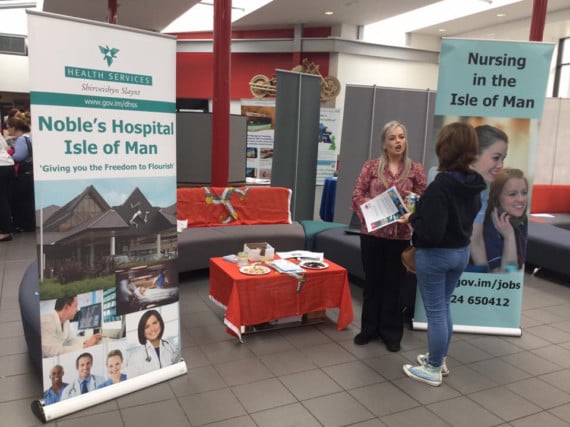
One of the ways they do this is to attend four or five recruitment fairs each year.
These are typically organised by universities or the Royal College of Nursing.
These are very cost-effective and targeted when compared with, for example, the price of an advert in the [UK] national press.
They have a purpose-made Isle of Man stand with lots of photographs to give an idea of life on the island and the working environment.
Linda said: ’We take junior staff to the fairs so that students and other junior staff there can talk directly to them about their experience working on the island.
’You might not see the fruition right away but it’s getting your name out there and when people qualify, or their circumstances change, or they just decide they want a completely fresh start, then that will come back to their minds.’
One key obstacle to recruitment was also removed quite early on as part of the strategy Linda implemented:
’One of the things we did do in the very early days, in 2015, was to remove nurses from the work permit process. It’s a big commitment to move here so we aimed to make that as easy and smooth as possible.’
But of course not all recruitment is coming from off-island and the ’grow our own’ policy, another key element of the strategy, is going to be vital for the future because the national nurse shortage around the UK is only going to get worse, as Linda explained:
’Students no longer receive a bursary in the UK to complete their nurse training. That’s only just commenced this year so they’ve seen a national shortage of applicants applying for nurse training there and the effects of that will only be felt in a few year’s time.
’I think going forward we’re going to be in an even more competitive pool.’
Fortunately the Isle of Man has implemented a fully accredited training programme for adult and mental health nurses and we still give them a bursary for their training.
Linda said: ’Since 2015 we have increased the numbers of pre-registration students so we currently have 20 students per year going through the training.
Obviously, because it’s a three-year programme, at any one time we’ll have 60 pre-registration students across our services.
’We’ve just agreed a partnership with Salford University to commence midwifery nurse training, with two places for the first year as a pilot, starting in 2018.
’We also currently take Salford University students on their midwifery practice training and we’ve been doing that for about three years. We’ve built up a really good working relationship so they know the students are getting a good placement when they come here.
’A number of the students who have come from Salford have chosen to work here at the end of that so that’s another route of increasing recruitment to the island, through partnerships with universities.’
Comments
This article has no comments yet. Be the first to leave a comment.