

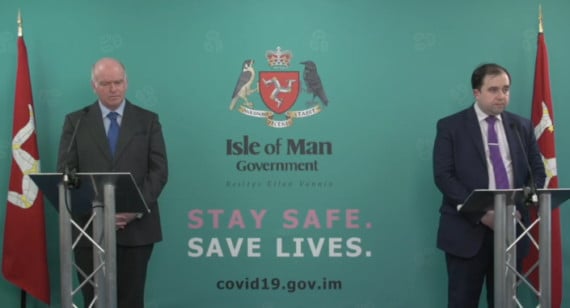
It’s the first anniversary of the island’s first case of Covid.
Since that first Covid-positive case arrived back from a holiday in Spain, there have been a total of 1,432 cases.
Over the last 24 hours, there have been 21 new cases, four of them of unexplained source, taking the total number of active cases to 862, with 20 in hospital (four in ICU). One patient has been sent off island for further treatment.
There are 2,709 people currently in self-isolation.
.jpeg?width=209&height=140&crop=209:145,smart&quality=75)
Chief Minister Howard Quayle said restrictions could not be eased before April 6 and all restrictions could not be lifted until at least April 12.
Public health director Dr Henrietta Ewart said: ’The numbers are going down, albeit more slowly than we would like to see.’
She said the continuing number of unexplained cases could be because of the behaviour of the Kent variant of the virus which seems to have a longer infective period.
But she said it could also be because people are not following the lockdown rules.
Mr Quayle said the contact tracing team have again had to step into a local business where an employee had been going in with symptoms and subsequently tested positive. He said: ’I have mentioned this before and have to say it again. If you have any Covid symptoms, stay at home and call 111.’
Mr Quayle said as things stand, he cannot imagine being able to make significant changes to our measures before April 6.
He explained: ’When we came out of restrictions in June last year and January this year we had solid periods with no unexplained cases. Twenty five in June and 21 in January.
’Although our vaccination programme is delivering at pace, we still need a decent safety period to know that the virus is under control.
’We judge that we are realistically looking at a date of around April 6 before we can safely consider releasing some restrictions and probably April 12 before we could envisage a full release of restrictions.
’This is assuming of course that we continue to reduce and then eradicate the unexplained cases.’
This means hospitality, non-essential retail, lifestyle or other businesses won’t be able to open until after the Easter weekend.
The Council of Ministers also agreed it would only look to reopen schools after the Easter Holidays.
And construction and related trades won’t be able to return to work as hoped next week.
Mr Quayle said: ’We may be able to bring back some outdoor activity for people and we may be ready for outdoor construction to resume as a first stage. Hopefully around April 6.’
The Council of Ministers has agreed that given the fact that the lockdown will continue for longer than originally hoped, it is ready to allow those who are living alone or lone parent families to access support - whether that is emotional or practical - from another single household. ’This does not mean a free for all. This means a one- to-one relationship with another household,’ Mr Quayle said.
On Thursday Tynwald endorsed the longer-term exit plan.
Mr Quayle described this as a ’living document’ that gives an idea of where we are heading and what the milestones might be.
He said the Noble’s Hospital is under incredible pressure as peaks in hospitalisations often follow about 10 days after peaks in cases.
More than 25,000 people have now received at least one vaccine dose - including the Chief Minister who said he had first jab today (Friday).
He received the Oxford Astra Zeneca jab that has been the all-clear by UK and European regulators amid unproven blood clot fears.
’As someone who is - shall we say - "needle shy", I can happily report that I genuinely did not feel a thing as the vaccination was given to me,’ he said.
Health Minister David Ashford said it had been decided to move to deliver the second dose at 12 weeks to ensure a stable roll-out continues despite a slowdown in supplies.
Next week will see vaccination clinic held for adults with learning difficulties.