
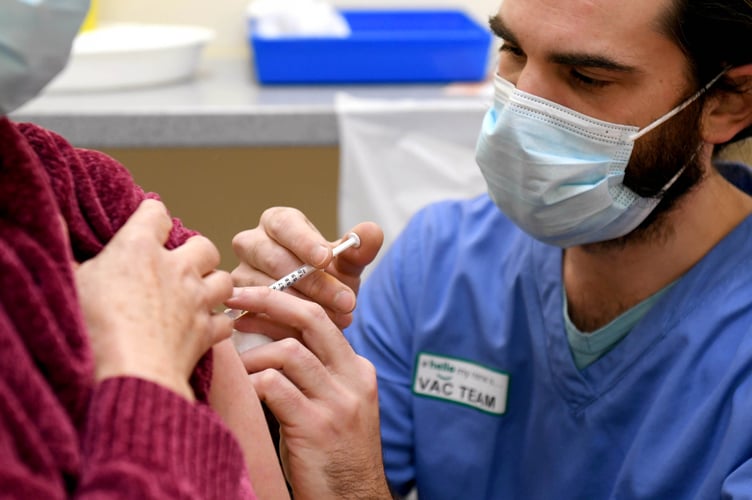
The Health Minister has reiterated that Covid-19 jabs will not be compulsory for frontline health workers.
It’s after the UK government last week backtracked on its own decision to make them compulsory for frontline NHS staff in England.
The policy had meant frontline workers would have had to be fully vaccinated by April 1.
They would have had to have received their first jab by last Thursday (February 3).



.jpeg?width=209&height=140&crop=209:145,smart&quality=75)
Staff had faced redeployment or dismissal, prompting protests against the policy and some NHS workers considering moves to other UK nations.
UK Health Secretary Sajid Javid defended initially introducing the policy to MPs, insisting the government ’makes no apology for it’.
But he added: ’Subject to the responses and the will of this house, the government will revoke the regulations.’
Speaking to the Manx Independent, the Isle of Man’s Health Minister, Lawrie Hooper, said: ’The answer has always been no, we’ve got no plans to do that.
’It would be different if we were forced into it by the regulators for example, so if the General Medical Council decided to make it mandatory as part of a condition of registration, then that would be out of our hands.
’But we were never going to do it. The UK have obviously decided that it would cause more harm than good and have changed their minds as well, so that’s great to see they’ve caught up with us on that.’
According to statistics available on the government’s Covid-19 dashboard, which list the island’s Covid-19 vaccination statistics, all of the island’s frontline health and social care workers have had at least one vaccination.
The island’s frontline health and social care workers are grouped into a priority group with ’all those 80 years of age and over’.
Of this group, the entire eligible population has had one jab, 99% have had two, and 88.83% have had their booster.
In fact, the dashboard states that there are 7,720 people in this priority group, with 7,935 first doses administered - meaning 102.78% of the eligible population have been jabbed.
This inaccuracy comes from the fact that individual priority group populations are initially derived from age banded GP registrations, and people may move between groups, or perhaps have entered/left the health service.
Where it is known that an individual exists in more than one priority group (ie staff in groups 1 & 2 and those in clinical groups 4 & 6) their respective age band priority group has been adjusted accordingly. This means the vaccination is recorded against the cohort in which it took place, not the age group to which the individual belongs.
However, as the government has stated clearly online, ’not all duplicates are known and as with any mass data entry system there will be a degree of data inaccuracy, therefore some group level populations may not be 100% correct’.
It’s after the UK government last week backtracked on its own decision to make them compulsory for frontline NHS staff in England.