
There will be no return to normality as we knew it for some time to come, the government has warned as it published its Covid exit strategy.
Measured easing of restrictions are planned as part of a phased return to work, with the next possible changes to be announced on Thursday.
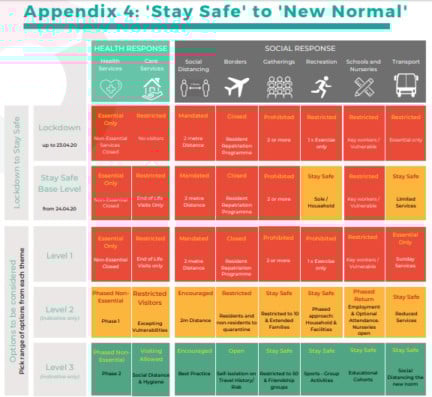
It gives hope that extended families could be reunited at last with gatherings of up to 10 allowed at some point. Another option could see gatherings of up to 50 allowed if there is low or no community transmission of coronavirus.
School hubs could be expanded to support the children of employees gradually returning to work.



But the Education Minister has already warned it could be later this year or into next year before all children are back at school.
And restrictions could be reimposed if there is a spike in cases.
Chief Minister Howard Quayle told a press briefing yesterday (Monday) that we are still not quite at the point to lift restrictions on meeting with family members from outside your household - although this is the single one thing many feel would make the lockdown more bearable.
But he said the latest guidance from the clinicians was that you can have face to face conversations with members of your extended family so long as you don’t go inside their home and keep 2m apart.
They suggest visiting at pre-arranged times and talking to a loved-one while they are at the window or doorstep and you are in the garden or in the street.
The medium-term strategy document, published on Monday, sets out a framework for how the government will, at the appropriate time, approach the easing of restrictions that were put in place to reduce the spread of the virus and save lives.
STAGES
There are three stages of the response: Stay Home, Stay Safe and New Normal.
We have now moved into the Stay Safe stage. This involves a phased return for businesses in some sectors and enabling the community to have more scope to leave their homes for exercise and recreation.
The document notes: ’The current downward trend in daily positive Covid-19 cases gives us confidence that our approach is working.
’The sacrifice from everyone in the community has been monumental. Businesses have struggled and individuals are struggling financially. The social costs have been significant.’
Unemployment has increased to levels not seen for over two decades. There has been an increase in the number of mental health calls to the police and incidents of domestic abuse have grown.
Financial measures put in place to support jobs and businesses are not sustainable in the long term, and there is a considerable loss of government income due to reduced economic output.
Without a plan to return to normality, the future viability of the Isle of Man would be at risk, says the document.
A six-phase return to work began with construction and horticulture on April 24.
Non-essential retail and services will follow, then restaurants and cafes, lifestyle and tourism, bars and nightclubs, and finally the reopening of the borders, a move that will depend on how the UK has controlled Covid.
Where new measures are put into place, between eight and 14 days will be allowed to assess whether there has been any change to the underlying trend in the number of new cases.
PROCESS
The Chief Minister stressed that the document is not a timeline and that the approach may not be a linear, one-way process.
He said: ’Our phased approach allows the government’s approach to flex, enabling us to move back and forth between phases if the evidence shows that there is a resurgence in Covid-19 cases.’
Mr Quayle added: ’There remains a long road ahead which will continue to bring considerable challenges.’
The first case of coronavirus was reported in the island on March 19, three days after a state of emergency was declared.
The following week the border was closed to all but critical workers and the schools were closed.
Since then, the lockdown has been extended beyond its initial 21 days. There have been 23 fatalities, the majority relating to residents at the Abbotswood nursing home. The latest death in hospital, announced yesterday, is not linked to the care home.
But the infection curve has been suppressed to a level even below the modelled best-case scenario.
Four extra cases were announced yesterday, taking the total to 325. None are related to the newly reopened construction and horticultural sectors.
Mr Quayle said there are real harms that flow from a sustained lockdown and any measures taken must be sustainable, fair, and enable good physical and mental health.
TRANSMISSION
Government will assess the overall risk of increased transmission based on the rolling three-day average of coronavirus cases.
But the strategy document gives out mixed messages. In one section it says no gatherings will be allowed under Stay Safe but elsewhere it talks of the option to allow gatherings ’restricted to 10 and extended families’.
Comments
This article has no comments yet. Be the first to leave a comment.