
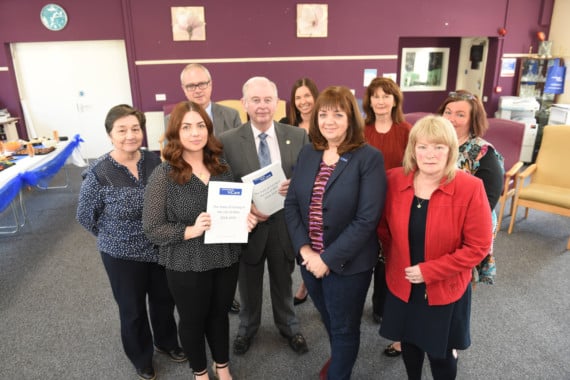
It’s very hard to convey the physical, mental and emotional toll that caring for another person 24/7 takes. If you have ever spent any time being a carer you will know this. Crossroads Care has been asking some of the families it supports about their experience of caring and the result is a recently-published report, ’The State of Caring in the Isle of Man 2018-2019’. Julie Blackburn has been looking at its findings.
The survey was sent out to every one of the 232 families on Crossroads’ current client database though the charity’s CEO, Jackie Betteridge, said she believes that there are actually ’many thousands’ of carers in the island.
Figures in the UK have shown that three in five people can expect to become a carer at some point in their lives.
Mrs Betteridge said: ’The survey was designed to gain insight about how local carers feel about their caring role and to ensure Crossroads’ services were reflecting the actual wants and needs of carers.’


.jpg?width=209&height=140&crop=209:145,smart&quality=75)

The charity defines a carer as ’someone who provides unpaid care and support to a family member, friend, partner or neighbour whose health and well-being would suffer without their help. This could be due to illness, disability, frailty, a mental health issue or addiction or substance misuse problems’.
It adds that a carer can be ’any age, child or adult’ and results from those who responded to the survey bear this out, with the age range varying from 11-18 years (8%) to over 80 (5%) with the biggest group aged 40-59. The majority (82%) were female and 20% care for more than one person.
The report showed that the overwhelming impact of being a carer is on their emotional and mental wellbeing with a massive 76% saying that they have been affected in this way.
One said: ’[I’m] constantly mentally tired, have been recently diagnosed with anxiety and depression due to stressful life.’
Another reported having had a nervous breakdown due to the strain of caring and other comments included: ’constantly worried’, ’worn out’ and ’tired, stressed, anxious, worried’.
There is also a big impact on families’ incomes, and on the wider Manx economy. A large number of the carers who responded to the survey (51%) are currently in full or part time education or employment but many are finding it a strain or have had to give up working altogether.
One comment summed up a number of responses: ’As the health of the people I care for has deteriorated I have no longer been able to juggle work with caring and had to give up my job.’
Another said: ’Juggling a job with caring responsibilities and home responsibilities as well as managing school holidays feels like too much to think about’.
Not surprisingly figures in the UK show that two thirds of carers have been affected financially, yet their contribution to the economy is immense.
In the island alone it is estimated at between £40 million to £90 million each year. More than half are not entitled to receive Carer’s Allowance, currently £116.60 per week, because they earn more than £126 per week.
One carer said: ’Because I work and own (mortgage) my home I am not entitled to any support except Attendance Allowance. If I need carers in or my husband needs to go somewhere overnight I have to pay private which I can’t afford to. The government only look at what you earn and don’t take any of your outgoings into account.’
Another huge impact of caring is on a carer’s social life with many reporting feeling lonely or isolated: ’trapped’ was a word frequently used.
Clearly carers need, and deserve, support and one important element of this should be a regular Carer’s Assessment, usually carried out by a social worker, to give carers the opportunity to access information, support and help.
But when it came to carers’ assessments, the survey revealed a shocking statistic as Mrs Betteridge explained: ’Having an assessment is a carer’s statutory right, the survey found that 79% of carers are unaware of this, so clearly it is not happening.’
She added: ’Crossroads has the expertise, and the capacity to carry out these assessments and I would urge any carers who feel that they would like to be assessed to get in touch with us.’
Crossroads is not the only care giving organisation and many carers will get day to day help provided by the DHSC, though this service is currently struggling with low staffing levels.
Others with the resources to do so will pay for care from private nursing and care agencies.
Mrs Betteridge explained where Crossroads fitted in to the overall care picture in the island.
She said: ’The gap that we’re plugging is providing trained care support workers, nursery workers and youth workers who go in and take over the caring responsiblity.
’This in turn allows carers a much-needed break.
’The care we give is very safe and very consistent and we are very proud of that.’
Crossroads Care, which is an Isle of Man registered charity, provides 160,000 hours of care each year. Mrs Betteridge says this is saving the Isle of Man Government ’millions’ and, although the charity does receive some government help, it still needs to raise £1 million every year to keep providing its services.
These are wide-ranging and include Care at Home where support workers take over the care responsibilities in the home, allowing the carer to have time to themselves; a high quality day centre for older people with disabilities giving carers respite through the day, and a nursery which is inclusive and fully integrated and which gives parent carers the opportunity to resume work or training.
There is a holiday scheme which runs activity sessions for children with complex care needs during the school holidays and the Building Bridges project which focuses on helping young people with learning difficulties to make more of their lives and engage fully with the community.
And there is valuable support for young carers with fortnightly sessions giving children who are caring for a parent or sibling, often as a primary carer, some space and time to be themselves.
Mrs Betteridge said: ’Our report is an extremely important document in terms of showing how our carers are not being appropriately supported. The statistics and comments in the report highlight that more must be done to improve the lives of carers and ensure their ability to provide care in the future and therefore it is essential that we help them.’
l You can download a copy of the report, which was written by Crossroads fundraiser Meghan Faragher, at www. crossroadsiom.org
Comments
This article has no comments yet. Be the first to leave a comment.