
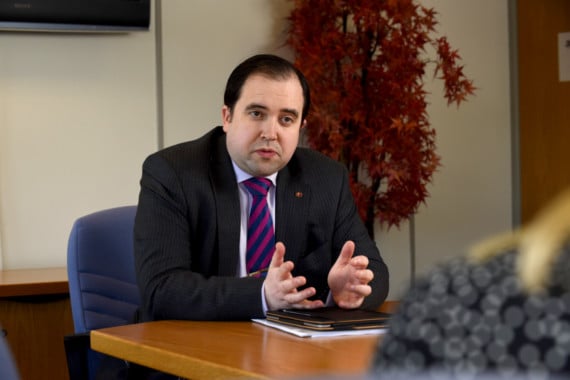
It’s the biggest department in government with more than 2,000 employees and David Ashford has been in post running it since January.
That’s long enough to have got a feel for the challenges and budget constraints that will necessarily temper his vision of how he would like to take the department forward so it seemed like a good time to talk to him about his first impressions and what he would like to achieve in the role.
He is not about to start blowing his own trumpet, and merely says he is happy to report that ’nothing has gone badly wrong so far.’
This, though, is as good a basis as any for taking things forward in - maybe - a new direction. Mr Ashford, a self-confessed history enthusiast, looks at things through the lens of the past, taking into account the lessons that have been learned.



.jpeg?width=209&height=140&crop=209:145,smart&quality=75)
He says: ’What people expect from healthcare has radically changed.
’On July 5 this year we celebrate 70 years of the NHS, and I do mean celebrate because it’s a unique healthcare model, but one of the reasons the NHS had stood the test of time and survived 70 years is that it has adapted and changed over that time.
’If we were still running off the 1948 model it probably would have collapsed under its own weight in the late 50s early 60s.
’One of the big differences now is that, when people are seriously ill, they want to be in hospital but as they recuperate they don’t necessarily want to stay in hospital. They want to have options to go home and, maybe through visits from the district nurse, be treated at home or be assisted by family members.
’Even coming towards end of life people want to be in their own homes and in a community and family setting and that’s what we need to be able to adapt to be able to provide.’
All of this feeds into Mr Ashford’s belief that the future strategy to provide more community healthcare ’hubs’ is the way forward:
’I’m very keen on that because what we’ve got to do is to start moving away from being an illness service to being a wellness service.
’This is something that jurisdictions around the world have struggled with but our healthcare model, I feel, is still a very old model - my personal term is an "after the fact" model. Someone gets ill, we treat them, we hopefully cure them and we push them back out of the system but what we’ve not really been that good at focusing on is preventative care, in terms of seeing the signs and doing it early.
’When we do treatment now it tends to be in an acute setting but if we can catch things early it’s much better health outcomes but also it’s cheaper to do.
’So we need to be moving more to a community-based model and that’s where the hubs that are designed and the strategy of having the four regional hubs around the island, which is in the health strategy that’s currently in place to be delivered, comes into play.’
Ramsey District Cottage Hospital, he adds, is an excellent example of how a communty hub could work, offering, among other things, the chance for patients to recuperate following a stay in hospital in their own local community: ’That way you’re releasing the pressure on your acute hospital. Also there is a minor injury unit in Ramsey, that is open to anyone on the island. If you can get minor injuries units into those community settings as well it could relieve the pressure on A&E.’
’The model for what exactly the hubs will offer needs to be firmed up and agreed but personally I think what we’re doing in Ramsey is a great starting point.’
There is, he reports, steady progress being made as sites around the island have already been identified so that, eventually, there will be hubs in the south, east and west to complete the community aspect of the service.
Essentially, the idea of moving from an illness service to a wellness service, with earlier treament and more preventative measures, is Mr Ashford’s Big Idea and also, he says, what he sees as his biggest challenge for the future.
’I know that’s all-encompassing but it’s that change in culture, it’s getting people to realise that there’s ways of treating them in the community.’
Key to any changes and improvements he might wish to make is of course his staff and I ask him about morale in the health service.
He says: ’I’ll be perfectly honest, I think that there are areas that have got fairly good morale and then there are other areas where I think people feel that it needs to improve.
’One of the duties in the system is to make sure that people feel they are listened to. Communication is key, especially good, old fashioned communication - talking to one another. We want staff feeling that they’re working in an environment where, if they’ve got ideas, they can come forward and express them, or if they’ve got concerns, they can come forward and express them. I’m already having conversations in the department about what we can do to facilitate that.’
I ask him which advances in health care he is most excited about and he mentions the great strides that have been made in treating cancer and also the digitisation of patient records, recently completed, which will eliminate 16m pieces of paper and help to smooth the way for patients in the system.
And, ever the passionate historian, he cannot resist adding another little nugget from the past.
He says: ’One of the interesting things when the NHS first started was that two of the top conditions that the original NHS was treating were rubella and polio - with very different health outcomes than we’d have today. That shows how things adapt and move on.’
Healthcare, and how it is delivered, is a subject that will affect us all at some stage in our lives but Mr Ashford wants to be sure that we also remember another area of his remit. ’
The focus always tends to be on health and I’m very keen the social care aspect doesn’t get forgotten about,’ he says.
’It is just as important. It is a stressful environment and I think we’re very lucky with the dedication of the staff we have.
’They work long hours in a stressful environment both, in health and social care, and I really can’t praise them enough because they go above and beyond, day in day out, and are passionate about delivering their job caring for people.’
On a final note, I ask him to look into the future, when he finally leaves his role: what would he like his legacy to be?
He says: ’I think it goes back to where we have got more of a wellness service, we have got the strategic hubs in place and we are delivering care where people require it the most.
’In terms of social care that we have adequate provision for those who do require increased social care - I think that’s the target.’
Julie Blackburn talks to Health and Social Care Minister David Ashford about morale in the department, community hubs and his vision for the future of the service.
Comments
This article has no comments yet. Be the first to leave a comment.