
As you’re walking across sodden fields in torrential rain to check stock, the idea of farm animals being ’therapeutic’ might not be uppermost in your mind.
But at the Isle of Man Children’s Centre Children’s Farm in Braddan they are seeing youngsters being transformed by their experience of tending the animals and growing produce.
Children’s Centre head, Joff Whitten, has a story that illustrates this very clearly. He says: ’One of our young ladies was struggling to communicate within school.
’She’d become "selectively mute", as it’s called: she wasn’t talking to parents, wasn’t talking to peers, wasn’t really talking to our practitioners when she was coming here.
.png?width=209&height=140&crop=209:145,smart&quality=75)
-(2).jpeg?width=209&height=140&crop=209:145,smart&quality=75)
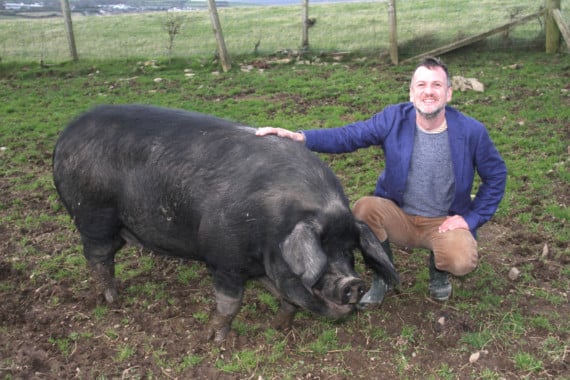
’But she got involved with the feeding rota and the practitioner overheard her speaking to Precious, our pig, and saying: "here’s the food", or: "you love potatoes don’t you?" - just simple words but nonetheless really impactful.’
The Children’s Centre, and the farm, is a completely independent Manx charity, not a government funded entity. Their focus is on working with at risk children, young people and families.
Joff says: ’That’s whatever risk there might be: it could be poverty, it could be lifestyle, it could be mental health, it could be physical health. It can be within school, or within communities, or within a family, that puts a young person at great risk.
’We do long term programmes, working mostly on a one-to-one basis, with young people to give them confidence, skills, resilience and opportunity. For example, a lot of our work is with young people excluded from school for whatever reason and we help grow them back to feeling that school is a place that can offer them some opportunity.’
As Joff gives me a tour of the farm, I get to meet Precious, 12 years old and one of the largest pigs I’ve ever seen. I give her a potato and I can vouch for the fact that she does, indeed, love them.
She is one of the animals at the farm, along with sheep, rabbits, chickens and runner ducks.
Joff says: ’I call them therapy animals and that’s the reason we have them: just for interacting with nature if you will. We all need to eat, we all need warmth we all need companionship and that’s essentially what the animals are here for. Young people will come and feed and talk to the animals but the growing is quite important too.’
For this reason the farm also has three polytunnels, which are impressively full of plants, flowers and produce. There are tomatoes, chillies, strawberries, herbs, onions, beetroot, courgettes, and pumpkins for Hop tu Naa. In one, a water feature provides a quiet area for reflection.
Joff says: ’If you’re planting something and coming back and nurturing and supporting it,changing it from a small pot to a big pot, there’s a lot of metaphors there about encouraging young people and growing young people.
’Each polytunnel has a different theme: one’s more to do with teaching; one’s more to do with therapy, and one’s more to do with produce.
’The produce one has a little experiment going on in it of growing a large variety of chillies from around the world.
’These end up as chilli sauces or dried chillies and there’s quite a lot of buzz around today because we’ve grown one of the hottest chillies in the world, the California Reaper. It gets ground up and I believe we’re going to try and make it into a dragon sausage: it’s incredibly hot. We’re working with a butcher who’s experimenting with them.’
They aim to grow following organic principles and to run the polytunnels as a social enterprise.
This means that as much of their produce as possible is either sold or used in some way: a partnership with Close Leece means they are using some of the farm’s produce in their kitchens and offering some for sale in their farm shop.
They also do some work with schools explaining to children the principles of ’field to fork’: ’You should have an awareness of where your food comes from,’ says Joff.
As well as growing produce and looking after the animals the young people can also gain other skills, such as tractor repair and carpentry.
There is a metal workshop with a forge and furnace and a fully kitted-out woodwork shop.
The Isle of Man Arts Council recently helped them purchase a kiln and they are redeveloping a long barn on site where creative crafts such as ceramics, glass work and enamelling can take place.
The Children’s Centre, which is now based and headquartered at the farm, works with around 40 young people a week. Not all of them will come to the farm and this is because not all are willing to leave their ’safe space’ so they will be visited wherever that is.
Joff says: ’One of our challenges is that we’re pretty much full but the sad thing is we’re getting an awful lot of referrals each week .
’There’s need for the work we do, and there’s understood need for it, so my role is to try to get as much resource behind us to deliver against that need.’
One of the common problems for the young people they see is bullying.
Joff says: ’It is always a challenge and it’s getting more pronounced.
’It’s not necessarily that there is more bullying but that it’s having more impact on young people’s wellbeing because of social media.
’In our connected world people are becoming more isolated which is a strange irony.’
It’s something they aim to address at the farm, giving young people new connections and the chance to forget their own problems as they care for animals and plants and learn about all the positive benefits that brings - whatever the weather.
Comments
This article has no comments yet. Be the first to leave a comment.