

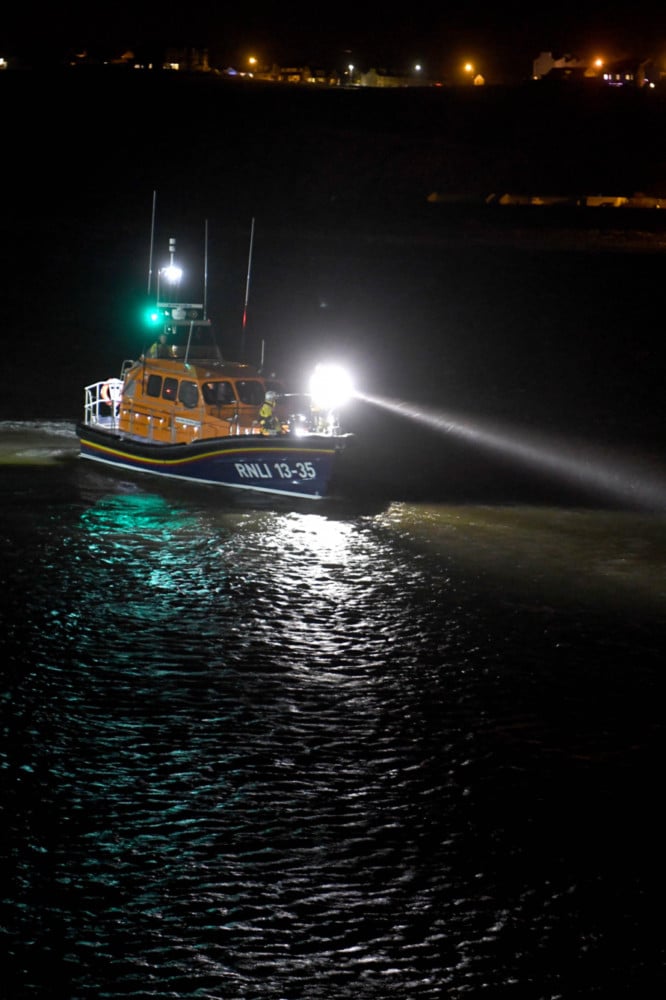
The first thing that struck me about the Shannon was how imposingly large it looked within the confines of the boathouse.
In fact, as the boat is driven out on its specialist launch vehicle - the SLARS (Shannon launch and recovery system), the whole platform is then able to raise up to a height which would not have been able to fit through the doors.
The SLARS itself is an impressive piece of equipment, a large, track-driven tractor with a long, flat bed attached to the front - on which the lifeboat is mounted.
This allows the Shannon to be deployed and recovered from the water far more quickly than conventional means of using the harbour’s slipway.


It is also safer, as all crew members can be seated and harnessed in for launch, with none required to be on deck.
The boat is positioned by the tractor on the slipway, inclined on its platform, and then released into the water.
On boarding the boat, I was impressed with how spacious, modern and comfortable the cabin is.
This feeling of safety goes beyond aesthetics, as the Shannon was expressly designed with crew and passenger comfort in mind.
A key feature is the seats’ hydraulic suspension which protects the crew member’s spines from the shock of rough waves.
Indeed, the comfort of riding in the Shannon can seem at odds with the choppy weather conditions and swell that you see out the window - because it is so protective and well-designed to handle rough weather.
One crew member mentioned that designers had considered keeping the coxswain’s seat fixed, so that the person piloting the boat would feel the stresses it was being subjected to, and therefore not push it past its performance limit without realising.
From a performance standpoint, the Shannon - despite being larger at just over 13 metres, and 18 tonnes - is much faster and more agile than the Mersey-class boats (which are 11.6m, 14.5t).
Most of this improved manoeuvrability comes from the fact that the Shannon is powered by two multi-directional water jet engines, rather than conventional propellers and rudders.
If you have ever stood on the back deck of The Manannan ferry and watched its jet engines swivel back and forth - those on the lifeboat operate in the same way.
The Shannon is even capable of performing a ’crash stop’ - braking and going from near top speed to a complete halt in an instant.
Unlike in a car’s emergency stop, the passengers feel no whiplash from this, and the deceleration feels almost gentle.
The jets also allow for an extremely tight turning circle and much faster cornering.
All of these state-of-the-art characteristics make the boat far safer for both the crew, and the people it needs to quickly reach and rescue.
Another basic, but new feature is the ability of the crew to communicate via headsets - as opposed to having to call out to one another.
I spoke to coxswain Jon Corlett for a first-hand, operator’s perspective on how the Shannon compares to the Mersey.
’It’s worlds apart,’ said Jon, who has volunteered with the RNLI since he was 16.
’A million times better.
’There was nothing wrong with Mersey, don’t get me wrong about that - it did everything we wanted for 30 years or so.
’But the Shannon, it’s more comfortable, it’s easier to use - easier for the crew.’
He explained:’The Merseys were a lot more complicated to use.
’[The Shannon’s] easier to use in that we can all multi-task, and we can all talk to each other.
’It’s brilliant, it just brings the whole crew together - because on the boat things can sometimes feel a bit distant.’
He explained that by contrast, in extremely rough seas the crew could be ’hanging on for dear life’ in a Mersey boat, and finding it difficult to communicate over the noise and vibrations.
’There was no shock-absorbing seats, just a wedge of foam,’ Jon said.
He continued: ’It makes us more effective.
’It keeps us safer, it enables us to do our job of saving lives at sea even better.
’Because we’re volunteers, at the end of the day.’
He added that in the Shannon crews would be ’twice as quick’ to respond to any emergency, and the boat has a longer range.
Everything on board is electronically operated, and equipped with the Systems and Information Management System (SIMS).
This allows crews to monitor the lifeboats’ functions on LCD screens from their safety of their seats.
One RNLI crew nicknamed it the ’Safety In My Seat’ system because it limits the need to move around the vessel, something which can be particularly hazardous in extreme weather conditions.
And as with all RNLI all-weather lifeboats, it is completely self-righting, and able to return to an upright position even if capsized in bad weather.
’Though that’s not something we want to test!,’ Jon joked.
While Peel’s Shannon lifeboat first arrived in March 2020, getting it into active service was delayed with the onset of the pandemic.
Border restrictions resulting in it becoming stuck in Fleetwood, where it had been sent to undergo routine maintenance.
The £2.2 million lifeboat finally became fully operational in October.
Like the Mersey, the new Shannon boat is expected to be in service for at least 25-30 years.
Peel’s old Mersey-class boat The Ruby Clery was then transferred to service with the Ramsey RNLI, which will also soon be getting a new Shannon, the Ann & James Ritchie 2, expected to arrive in the spring.
The Ruby Clery will then go on to join the RNLI’s ’stationless’ relief fleet in the UK.
Comments
This article has no comments yet. Be the first to leave a comment.