
The Manx Wildlife Trust is the island’s leading nature conservation charity, owning nature reserves, surveying the wildlife and keeping an eye on the challenges which face our island wildlife today.
In the last of this year’s monthly challenges, our thoughts turn to Christmas and our winter wonders.
In the island we have several Christmas tree plantations.
Not only are these conifer plantations local and sustainable, but they also provide excellent habitat for wildlife. The trees are always kept at a smaller height, which lets light down to the ground for the wildflowers and pollinators, and also provides good nesting areas for song birds.


-(2).jpeg?width=209&height=140&crop=209:145,smart&quality=75)
A lot of our plantations contain Sitka Spruce, larch and pine, with the three main plantations being found at South Barrule, Archallagan and on the slopes of Greeba mountain.
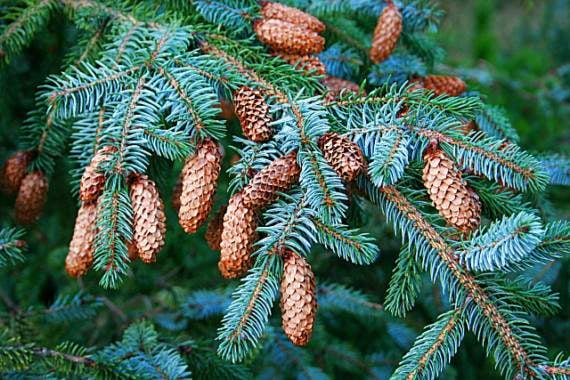
Coniferous means cone producing, and the distinctive cones, which fall of the trees in the autumn, are probably the most recognisable feature of coniferous trees. Interestingly, pine cones in particular make a good natural deterrent for slugs when mulched down.
Cones are actually the female flower which, when fertilised, hold its seeds between the scales. Pine cones can take two years to grow and contain up to 200 seeds.
Children in Finland and Sweden traditionally make toy cows out of pine cones, and the pineal gland in our brain, which governs our sleep patterns and our perception of light, is so called as it is pine-cone shaped.
When it comes to spotting the individual species of conifer, it’s all in the needles! They are a tell-tale guide to these trees.
Pines always have their needles in groups of two, three or fives, whereas spruce, hemlock and fir trees always have them arranged singularly.
Sitka Spruce
Originally from North America, the best way to identify this very common tree is to look closely at the needles, which are flat and straight with two pale bands running along the underside of it, with a tiny wooden peg at the base.
The bark of the tree is scaly looking and often tinged purple.
The cones feel papery and have overlapping scales, and grow centrally on the branch. The spruce aphid loves this tree which in turns brings in aphid eating insects which then brings in birds to eat them, so these plantations can be good for wildlife.
Larch
The needles on the European Larch turn a fantastic yellow colour in autumn and then drop off, and the Japanese Larch needles turn red. The bark is a slightly pinky colour and has large cracks in it. The needles are soft and grow in rosette-shaped tuffs. The male flowers are creamy yellow, and the female flowers are pink, green or white.
This cone is papery and small and round.
Sadly, our larch planation’s have suffered from sudden larch die back (phytophthora) and huge areas of them have had to be felled, with the Injebreck planation badly affected.
Western Hemlock
Another imported American tree, the bark is ridged and dark brown coloured. The needles smell of grapefruit when crushed and have two white stripes on the underside. Look carefully and you will see the needles growing on the sides of the twigs are longer than those growing on the top.
Why is it called hemlock? Well it is due to the smell of this tree being similar to the smell of hemlock otherwise they are not related! The cones are small with papery scales and hang down under the branches, often growing at the tip of the branches. This tree is present at Claughbane, near Ramsey hairpin.
Corsican Pine
This is a sub species, alongside black pine, and this tall and straight tree grows very fast, at a rate of 30 to 70 centimetres a year.
The needles are long, grow in pairs and are very rigid.
They can be straight or curved and have a serrated edge to them.
The cones are five to eight centimetres and have thick strong scales, with rounded ends, which grow centrally on the branch. The tree bark is greyish brown, can easily be broken off the tree and has fissures, or cracks, along it.
They are also long lived, surviving up to 500 years. They can be found at the Ayres plantation and Claughbane.
by Dawn Dickens
Biodiversity education officer,
www.manxwt.org
Comments
This article has no comments yet. Be the first to leave a comment.