
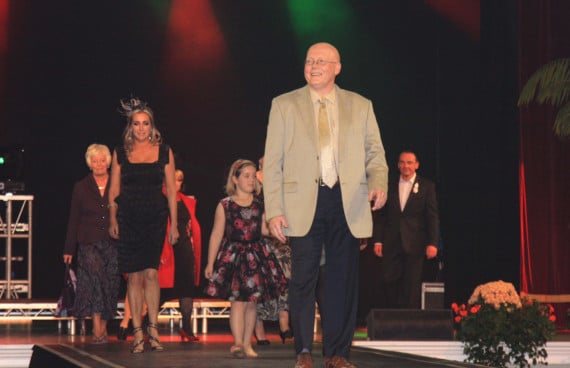
It’s not easy to get a man of a certain age up on the catwalk and it’s even harder to find one who will talk openly about having suffered from breast cancer.
Reporter Julie Blackburn meets Chris Barr, who is well aware that he is a bit of a lone voice in the wilderness.
Men are funny about breast cancer, he tells me over a coffee in Douglas.
And he goes on: ’First of all there’s so few of us [who have had the disease] and then the men who’ve had it don’t seem to want talk about it.


.jpeg?width=209&height=140&crop=209:145,smart&quality=75)

’I can’t understand why because I don’t have any embarrassment but for some reason men do not want to to come out of the woodwork.’
Chris will be strutting his stuff in London on Thursday at the national Breast Cancer Care Fashion show, a glitzy event compered by Victoria Derbyshire.
ITV will be covering the show for the regions so we can expect to see it on our screens too.
’Last year they made £320,000 for breast cancer research so it’s a big fundraiser,’ he said.
It’s the second time he has done the show and he has also taken to the catwalk for the Fashion for Life show at the Villa Marina in aid of Isle of Man Breast Care and Breast Cancer Now. Put simply, Chris is on a mission to let men know that breast cancer ’is not just a woman’s disease’.
He was diagnosed in 2006, quite by accident, when he slipped in the bathroom and landed with his hand on one breast where he suddenly felt ’a hard lump’.
He can recall the moment with complete clarity: ’As I was lying there I thought: "That’s odd".
’I just knew that there was something more to this.’
It was brought home to Chris just how easy it would be for a doctor to fail to diagnose male breast cancer when his GP said to him: ’Well it’s probably just muscular as you’re a man but if you were a woman I’d be a bit concerned.’
Luckily for Chris they still referred him to the hospital for further investigations.
In 1991 John W Nick, the head of the New York stock exchange, died when his breast cancer was misdiagnosed simply because it is so rare in men.
The consultant at the hospital told Chris that, as he had seen so few cases of male breast cancer, he would prefer not to operate himself.
Instead he recommended that Chris went to see a surgeon who had had experience with the disease.
Fortunately for him his role as legal director for Albert Gubay (he is now retired) came with private health insurance so he was able to go to London and see Mohammed Keshtgar at the Harley Street Clinic in London.
Mr Keshtgar treated Chris as an emergency, admitting him straightaway when he arrived for a Friday afternoon appointment and assembling a team over the weekend to operate on him the following Monday.
Chris had a mastectomy and 13 lymph nodes removed.
He recalls: ’I remember the next day I was lying groggy in bed and Mr Keshtgar came in.
’From his top pocket he brought out this little knife and said: "See that there? That’s what saved your life".’
He went on to tell Chris that: ’If you’d left this for a month longer you might have seen this coming Christmas but it would have been your last one.’
Following his operation Chris had chemotherapy and radiotherapy and spend five years on Tamoxifen, gruelling at the time but he is still here, 12 years later, and he realises how lucky he is.
A young man from the south of England who Chris met around the time he was having his treatment was 24 when he was diagnosed with breast cancer and just 28 when his breast cancer returned and he died.
On the Isle of Man there have been two cases of male breast cancer since 2014 and Chris made it known at the hospital that he would be happy to talk to either one of them if they needed any advice or support.
Neither has contacted him, a fact which provides a stark illustration of how different men’s and women’s reactions are to something like this.
As Chris points out, a woman would have got in touch like a shot, more than grateful to have found a fellow sufferer to talk to.
Chris says: ’One thing I resolved in my own mind was to throw myself into the breast cancer world because I feel it is important to raise the awareness of male breast cancer.’
Having discussed it with his former boss, Chris was delighted when Mr Gubay gave him his support, donating £0.5 million to Lester Barr who runs the Genesis Centre which looks into causes and effects of breast cancer and a further £0.5 million to Breakthrough Breast Cancer (since renamed Breast Cancer Now) which also raises money for research.
Chris has also joined the committee of Manx Breast Cancer Support and he says: ’The one thing I’ve found with all the breast cancer charities is they’re very accommodating. They’re struggling to get men to come forward so they’re very welcoming and they’re not woman-biased in the way they might appear to be.’
He adds with a smile: ’It’s amazing how my social life has changed. Now I go out with all these large groups of women. We go out for dinner and there’s 40 of us and you can see people looking and thinking: "Why is he there?".’
There is much talk at the moment about how much money is raised for breast cancer compared with prostate cancer.
Chris says: ’Who would have dreamt that Manx Breast Cancer Support could have raised £1.5 million in the island? Julie Stokes [their chairman] has passion beyond belief.’
And he adds: ’The difference between men and women is that women are so much more efficient and so much better at getting on with the job.’
Comments
This article has no comments yet. Be the first to leave a comment.