

My relationship with this island goes back to 1979, almost 40 years, says Mr Numata with a broad smile as he greets me at Patchwork Cafe in Port St Mary.
In those days he was working for Fuji TV, making a documentary about teachers aound the world. He had also developed an interest in Celtic culture and he was very impressed to meet Dollin Kelly, then head teacher at Santon School, and to learn that he was still teaching Manx even after the last native Manx speaker had died five years earlier:
’In the history of the human race it seldom happens - once a language has died out in many cases it is never revived,’ he says.
His association with the island continued, as he recalls:
.jpeg?width=209&height=140&crop=209:145,smart&quality=75)
.jpeg?width=209&height=140&crop=209:145,smart&quality=75)

’Usually I encountered [people I filmed] only once but my interest was so strong I came for a second time for my interest and pleasure and since then I was assigned chief of the Paris office so my access to this island was made easier. So I would come here at the weekend and go back to Paris on Monday morning.’
He got to know many other people in the island, including artist John Hobson Nicholson who revived his interest in drawing and painting and ceramic artist John Harper from Shebeg pottery on the Ballamodha.
He bought several of Nicholson’s original paintings and he also loved John Harper’s rustic animal figures:
’They are all of them so nice I bought many of those,’ he says.
Not only that but he also photographed them and used them on the New Year’s cards which are a Japanese tradition and usually feature the animal of that year in Chinese horoscopes.
He even sent some back to his growing number of friends in the island with the message: ’Here comes an unusual card from Tokyo, Japan’.
Mr Numata still comes here to paint and every year for the last ten years he has exhibited his Isle of Man paintings in Tokyo. These have included the lighthouse at the Point of Ayre, Laxey Wheel, Peel, Ramsey and Santon School.
’I am probably the Manx ambassador in Tokyo!’ he says with smile.
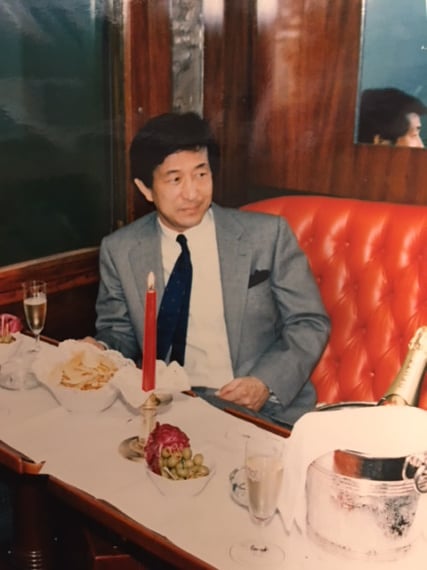
Whilst working in Europe Mr Numata also became very interested in the development of the railways, as he explains: ’After the railways were installed all over the European countries the numbers of the people that each person met in their lifetime went up by four times, so the invention of the railway meant great things.’
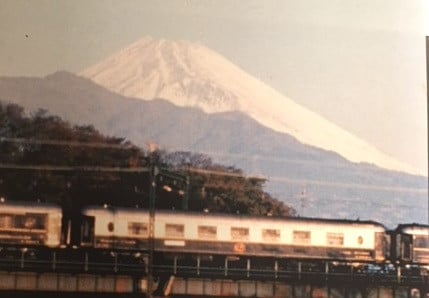
He had a particular interest in the Orient Express and, in 1988, this led him to embark on a project that everyone told him was impossible: taking the iconic train all the way to Tokyo.
’It was a very, very hard job,’ he admits.
The most practical route was through Poland and Russia to China but the political climate in eastern Europe was very different then.
This was before perestroika and the tumbling of the Berlin Wall but Mr Numata says that any cultural differences were, in the end, largely overridden by the universal love so many people have for the railways.
’In that sense I came to understand there are so many railway lovers all over the world.
’Critically they are quite different but the love towards the railway is what they have in common: that’s why my train was accepted so that train could pass by many, many borders.’ says Mr Numata.
This was just as well because the practical difficulties were also enormous. Most European railways run on a standard gauge track (the gauge refers to the width at which the rails are set apart) but Russian trains operate on a wide gauge railway.
This meant that all 32 bogies on the train (the structure underneath a railway vehicle to which axles and wheels are attached) had to be changed. As soon as the train reached China, they then had to be changed back again to accommodate a standard gauge railway once more.
On it rolled through China to Hong Kong. Mr Numata takes up the story:
’Then we had to take a boat and carry all 16 carriages over the sea to Japan.
When it arrived the wheels had to be changed yet again, to narrow gauge, to fit the Japanese railways.
’So my train had to change three times.’
In Japan another problem arose: coal is unobtainable there and had to be shipped in to run the steam engine and the cooking operation in the dining cars kitchen - special permission also had to be obtained to burn coal on board the train.
Until the trip Mr Numata says he was known in his working life as a sensible, careful person.
When he had the idea to do the Orient Express trip everyone thought he had taken leave of his senses.
But Mr Numata had the last laugh.
The trip was filmed all along the route and when they finally made it to Tokyo station - the final destination - the film was finished and sold to TV companies the world over.
He recalls: ’All of the railway people were very much surprised it was getting worldwide coverage most of the newspapers on the way wrote about it and broadcast.
’It was seen as a kind of a miracle and very foolish!’
Now in his seventies, Mr Numata still loves the chance to come to the Isle of Man and is still welcomed by his Manx friends. As he says with a smile: ’This island is more like my home town.’
Comments
This article has no comments yet. Be the first to leave a comment.