
With the restrictions resulting from the coronavirus pandemic now eased, the opportunity to get out and to stretch ones legs is a welcome treat.
The Isle of Man offers some fantastic habitats for our wildlife, and at this time of year, our coast - whether beaches, cliffs or shingle shore - has a wonderful selection of birdlife offering superb photographic opportunities.
And developing ones knowledge of the birds, their lifestyle, songs, habitats and feeding requirements is part of the joy of walking our coast and seeing them in action.
At the Point of Ayre, the arctic terns are again nesting in their own protected area on the shingle banks, behind rope barriers.
 Stabbing victim who dealt drugs narrowly avoids prison after 'turning life around'
.jpeg?width=209&height=140&crop=209:145,smart&quality=75) Drug dealer who sold cannabis for a year to be sentenced in February
Drug dealer who sold cannabis for a year to be sentenced in February.jpeg?width=209&height=140&crop=209:145,smart&quality=75) Pictures as displays of ancient Manx Christmas tradition raise hundreds for charity
Pictures as displays of ancient Manx Christmas tradition raise hundreds for charity Biker caught riding at nearly double the speed limit on hairpin bend
he shot included here of one such tern - identified by the ring on its leg as ’CX’ - is of particular interest.
The bird was ringed as an adult on 19th June in 2015, and CX has been a regular annual visitor, having been recorded in May or June every year since then.
Weighing in at just four ounces or so, arctic terns are superb, agile fliers - their light weight with small streamlined bodies, short legs and narrow wings makes for highly efficient flight.
Arctic terns are found throughout the world - from North America through Europe and into Asia - and famous for having the longest annual migration of all living animals. Summers are spent here in the northern hemisphere, up into the arctic and sub-arctic areas, and they then migrate to the southern hemisphere during our winter.
Since this trip is a ’meander’ across the oceans and continents rather than a direct flight, it adds up to a round trip of perhaps 40-50,000 miles each year, or equivalent to flying twice around the circumference of Earth. Astonishing but trueâ?¦.
Unfortunately, while the rope barriers are intended to keep us humans out, it doesn’t prevent predation of the terns, a particular problem being rodents and hedgehogs raiding their nests.
And climate change and habitat loss are other long-term issues still to be addressed.
Gannets are another beautiful bird often seen around the Ayres and off Ramsey Bay - sadly none nesting on the island but visiting to forage for food in our waters from places as far away as Pembrokeshire or Ailsa Craig in the Clyde estuary where there are large colonies in the breeding season.
Magnificent birds with a wingspan of six feet, they dive for their food to depths of perhaps 60-70 feet, using their wings to ’steer’ underwater, and with air sacs in their face and chest to act as shock absorbers during the dive, hitting speeds in excess of 60mph.
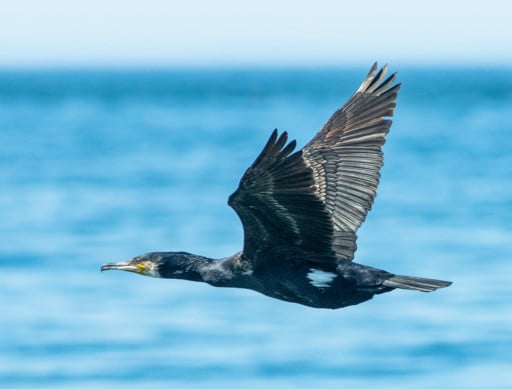
Cormorants and shags are not the easiest birds to differentiate, their appearance being very similar, though the adult cormorant is somewhat larger than the shag and with a thicker, more powerful beak.
The slim line of the head and white on the flank of our pictured bird confirms it as a cormorant. Unlike the terns, their wings are short to aid their underwater efficiency in chasing fish down to depths of 100ft or more, but, given their weight and size, the wings are then surprisingly inefficient for flying - hence they are coastal birds rather than oceanic.
As a keen but not very good ornithologist, I will confess that the camera is my main means of identification, taking a record shot and then going home to confirm the particular species seen, and to seek additional information on their habitat etc.
The camera has always been a means of recording events and occasions - combining this with a walk in our beautiful countryside seems a particularly useful and convenient feature of a camera.
Belonging to a camera club such as the Isle of Man Photographic Society will give opportunity to swap experiences with fellow members and to develop your skills. Have a look at our website - www.iomps.com or our Facebook page for lots of ideas to stimulate your interest.
Chris Blyth
Comments
This article has no comments yet. Be the first to leave a comment.