
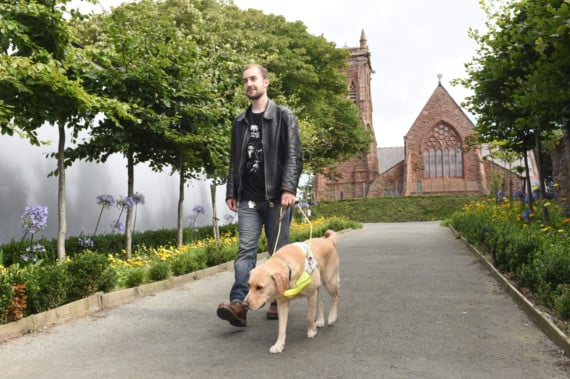
Most students feel a mixture of happiness, relief and pride on their graduation day but for Juan Greggor it went way beyond that: ’When I graduated it was magical, it was wonderful,’ he says.
It was an occasion Juan shared with his guide dog, Angel, who was suitably dressed for the occasion in her own graduation gown, custom made for her by the company which made Juan’s.
’She loved it and the crowd loved it as well. We got a standing ovation when we came onto the stage,’ Juan recalls.
His mum Linda who was also there with Juan’s sister, Ealis, says: ’I’m incredibly proud of both my children, they have done so well. They’ve overcome huge difficulties and a lot of the difficulties they’ve overcome they’ve used to their advantage. They’ve channelled their energies in a very positive way.’
.png?width=209&height=140&crop=209:145,smart&quality=75)
.jpeg?width=209&height=140&crop=209:145,smart&quality=75)
The difficulties Linda is talking about started for Juan at a very young age: he had neurological difficulties which affected his balance and coordination. These meant many visits to the hospital and numerous examinations and nobody took much notice when he also failed an eye test at school when he was five.
’I just thought he was sick of being poked and prodded and wouldn’t sit still properly for the test,’ says Linda.
But it was more than that. When he was eight years old Juan was diagnosed with retinitis pigmentosa (RP). It’s a condition which more commonly develops when people are in their 30s or 40s. Juan, they were told, had the childhood version, which is much more aggressive and progresses at a faster rate, ending in total blindness.
As if this wasn’t enough at around the same time his father Brian ’Bobba’ died of cancer.
Juan recalls the progressive deterioration of his eyesight: ’From about the age of seven or eight I started having glasses for classroom boardwork. I hated glasses, I didn’t want to wear them at all.
’Then I started having what they call "night blindness" as the retina was dying, so darkness grew bigger and any spots of light grew smaller so I’d work my way home directly under lamposts.’
’Then at 13 I was registered partially sighted.That’s when we started to notice that my peripheral vision was going and I started training with a long mobility cane. At 17 I lost vision in my right eye and I was registered blind.
’Now I can’t see anything in my right eye and in my left eye I can tell the difference between light and dark.’
Juan describes the effect of all this on his mental health: ’At 17 I was in my A-levels at QEII. In the October I dropped out because I was suffering quite a severe depression: teenager, male, losing sight - it wasn’t great. After I left, I wallowed in a pit for a little bit.’
In the end Linda took matters into her own hands. She told him: ’You’re struggling, we’re all struggling with it as well.’
She had suggested he went to Isle of Man College, as it then was, to do a course but he was resisting: ’I said to him: "You’re going to go to the college and do a course because if you don’t I’ll kill you!"’ she recalls, laughing.
So he went and it was the beginning of him turning his life around. After a year completing a course in business and administration Juan went on to do A-levels at the Royal National College for the Blind.
It was around this time that a very important relationship in his life began: he was matched with his first guide dog, Wilma, a beautiful gold retriever.
Juan recalls: ’Wilma was something special. She was very cuddly, very placid, very emotionally connected, which is exactly what I needed when I was very severely depressed.
’She’d just come by and lean on you and have a bit of a cuddle or if I was sat on the floor she’d sit on your lap or curl up between your legs’
After completing A-levels in psychology, sociology and English literature, Juan turned his thoughts for university degree. He had always loved psychology and this developed into interest in psychoptherapy and counselling.
He says: ’I wanted to help people. I started seeing a counsellor when I was at the college and started worked through some of my issues so that really informed my career choice.
’So then I started scouting for courses and the University of Central Lancashire were the best option by far. They were something special.’
UCLAN were only too happy to provide all the facilities Juan and Wilma needed and he embarked on a BA Hons course in counselling and pyschotherapy studies.
Then came another blow, as Juan explains: ’In March 2016 Wilma was diagnosed with pancreatic cancer, just before her fifth birthday and she was immediately retired.
’I then returned to university and Wilma had surgery at a vets in Cheshire. Then she came back to the Isle of Man because Mum wanted her back here and Guide Dogs felt she would live her life out the best way here. She was given six to nine months and she lasted two years.’
Guide Dogs matched Juan with another dog, Angel. Juan says: ’She arrived in July 2013 and we’ve been working together ever since.
’She is the chalk to Wilma’s cheese, completely different, very much a bouncy dog.
’She’s lovely, a very, very sweet dog but needs to be entertained constantly and needs to be kept tired. Wilma was quite happy to have a bit of a lazy day whereas Angel needs work every single day.
’Angel’s job is to guide me around safely and make sure I don’t walk into people or stray lamposts. Working is quite stressful for guide dogs as they have to threat monitor constantly.’
Juan describes taking until the age of 25 to complete his degree as ’an incredibly long journey’. In September he starts a practitioner course to become fully qualified, also at UCLAN, and as part of the course he’s hoping to get a placement with Cruse Bereavement. And of course Angel will be going with him.
As he says: ’Guide dogs are much more than a mobility aid, they are a companion, somebody’s best friend providing emotional support.’
Comments
This article has no comments yet. Be the first to leave a comment.