

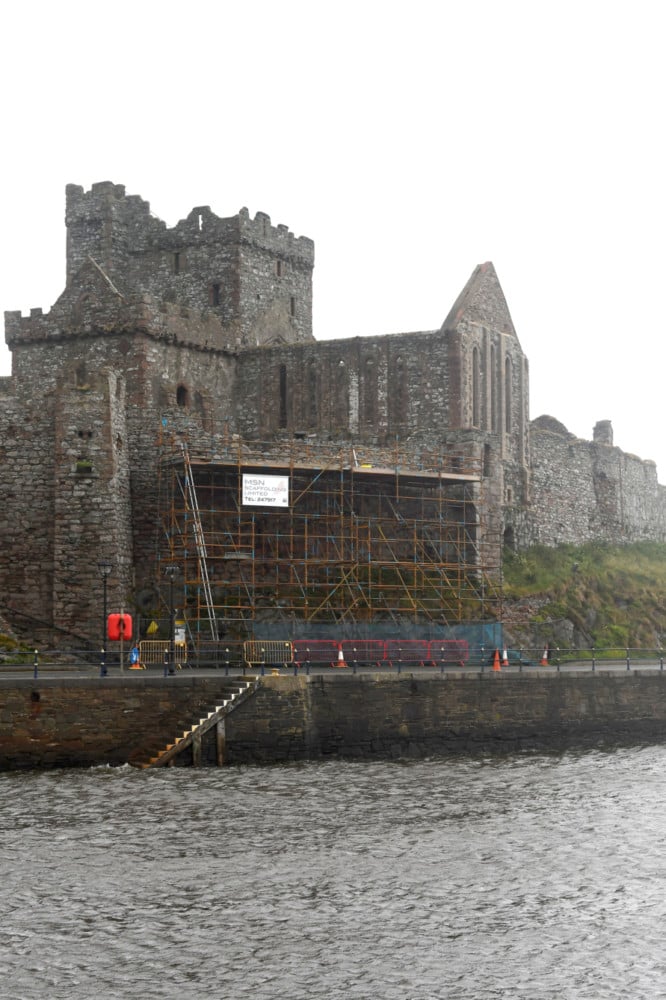
Stone masons and conservation experts have begun an operation to repair and restore a stretch of the curtain wall of Peel Castle.
As huge and impressive as they seem, the outer walls of Peel Castle, dating back to the 14th century, are in need of careful work and attention to ensure that the imposing fortress remains standing for many more centuries to come.
Archaeologists, conservationists and masons have started work on what is expected to be a nine-month period of work to repair a section of the wall, running from the castle gate house through to the south face of the cathedral, with the work required being described as ’painstaking’.
A large bank of scaffolding has been erected on the outside of the wall and a team of builders from Manx National Heritage, specially trained in old and conservation building techniques, have begun to gently peel away layers of crumbling stone work and weather-beaten sandstone, and rebuild the walls and parapets as faithfully as possible.



The work is being led by Andrew Johnson, inspector of ancient monuments for Manx National Heritage, who said that the team are working in a slow and considered way to make sure any repairs will be difficult to see once the work has finished.
Before any of the builders were allowed to remove any stone work from the castle walls, Andrew recorded and numbered each individual stone in the walls, enabling the builders to recreate the walls exactly as they found them.
’It is a painstaking process,’ said Andrew.
’We have taken photographs of each section of the wall, recorded the location of every single stone and what goes back will be exactly as it was.
’It will take a while. I think we will be on-site for most of the summer.’
The team of builders are trained in conservation building methods and will more or less use the same techniques as the original stone masons hundreds of years before, using lime mortar, sandstone and rubble.
Since 1860 there have been numerous repairs made to the walls around Peel Castle and the current works being carried out are to strengthen some of the earlier repair work.
Many of the repairs stem from an intense period of reconstruction during the 1870s, led by Governor Loch, who recognised the value of the island’s fortifications as tourist attractions. Loch enlisted the help of Robert Anderson, a noted expert in ancient building conservation at the time when such a thing was in its infancy.
’Anderson assessed and directed the repairs to the castle between 1870 and 1881 and massive amount of work was done to the ruins of the castle,’ said Andrew.
’A lot of the works they did have stood the test of time.
’You can see quite clearly the patches of sandstone around the castle walls. It was done sympathetically, using the same materials and imported sandstone that would match the original stone as close as possible.
’With a modern eye you could look now and say that some of the work could have been done better, but then building conservation was in its infancy and there were few people who saw the merits in preserving places like this.
’But we are talking about repairs done 140 years ago and everything has its lifetime. Part of the parapet of the front wall that was patched in the 1860s has started to fail and that is what we are concentrating on.
’We actually have a photo taken in the 1860s, with a hole in the curtain wall and with the ground level between the gatehouse and the cathedral at a much different, higher level before Anderson began his work. It also shows the condition of the Cathedral as it had stood for hundreds of years before then.
’As a student I worked on the castle in the 1980s. I did a lot of photographic recordings at the time.
’We are only the guardians of sites like these for the next generations to enjoy, admire and to study, and that is a great responsibility to take on.
’It feels amazing to be connected to the castle in this way and being entrusted to look after the walls and make sure they remain standing. ’
Comments
This article has no comments yet. Be the first to leave a comment.