
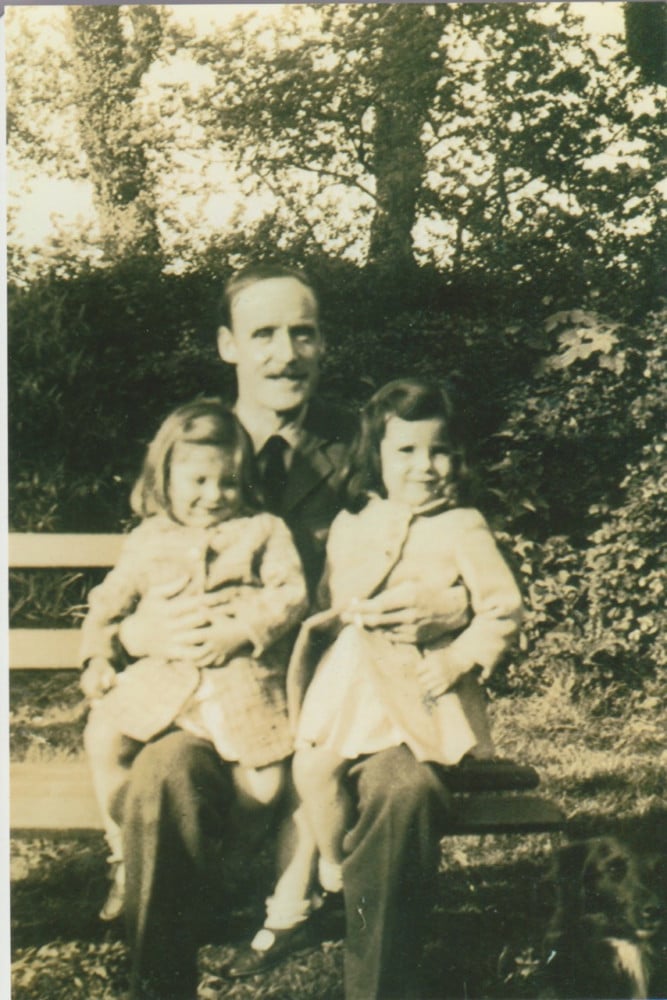
Sisters Margaret Smith and Jean Page, nee Magrath, from the south of England, decided to revisit the Isle of Man, where they lived when their father was stationed at RAF Jurby from 1943-46.
While searching online for information relating to Ballacrye Farm, their wartime home, Margaret found an email address for Sandra Kerrison, who now lives there.
During the war years, Sandra’s grandmother Lucy Curphey lived at Ballacrye and took in a number of RAF families. As chance would have it, Sandra is heavily involved with the historical exhibitions staged at Jurby Church and is author of the forthcoming book, Jurby and the RAF, so she was well placed to help the sisters plan their visit.
An exchange of emails followed and last month the Magrath sisters came to the island on a five-day visit. They spent a day at Ballacrye and also visited the current RAF Jurby exhibition organised by Sandra, who said: ’Although they were very young when they were last at Ballacrye, it was amazing how much they remembered. It was a strange coincidence that they should choose to visit after all these years, at the very time the RAF exhibition was being displayed at Jurby Church. Their story is now part of the display.’

The exhibition, which opens daily 10am to 4pm until Sunday, October 15, tells the story of 25 years of RAF Jurby, from the war years through to the closure of the station in 1963. It is estimated that 18,000 people trained there during that time.
There are photographs, reminiscences and stories of tragedy, drama and the sheer intensity of training, as well as the prosperity, status and glamour which the RAF brought to Jurby and to the island. Below is an extract from Sandra’s book:
’Many of those who came to the Station were there for a short time only and were housed in huts at the camp. Some of the local permanent staff lived in Ramsey. There was a great demand for married accommodation in Jurby and the adjacent parishes and the old farmhouses in particular could provide lodgings for several families at a time.
’There were often two or three families living at Ballacrye at a time. Each family had a room and the parlour was shared. They would have the use of the kitchen, which had a rough slate floor. Cooking was done over the fire and in the oil stove. There was no hot water and the veg was at the end of the garden. Leading Aircraftman Albert Ernest Magrath and his family lived at Ballacrye for a time during the war years and his daughter Margaret has shared her memories of that time:
’Dad went across to RAF Jurby we think sometime in 1943. We assume he was allocated living quarters at Ballacrye and then mum, Ivy Gladys Magrath, my sister Jean, myself Margaret and our wire-haired terrier, Tony, arrived later.
’Jean and I have some memories of living on the farm but we were only six and four when we returned to the mainland.
’We remember mum having her sewing machine in front of some very large windows which were blacked out each evening in the room we lived in and seeing her doing the ironing using irons heated in the fire.
’We feel sure there was a duck pond and a pump where we collected water. We remember being taken to the beach by a young lady called June. In 1944 mum’s sister Doris and our cousin Michael arrived at Ballacrye. Doris was pregnant and it was deemed much safer for her to be on the island rather than in London. Cousin Anne was born in a nursing home close to the farm and I think they remained with us for a while before returning home. Our mum was also pregnant and gave birth to our brother Ian on October 3, 1944.
’Possibly some of our memories are not quite right, it is a long time ago, buÂt we are sure we were all really happy there. In 1945 dad was demobbed but we feel we must have stayed on for some time as we think we returned home in the spring of 1946. We then lived in Eltham, Greater London, where our brother Alan was born in 1947.’
Comments
This article has no comments yet. Be the first to leave a comment.