
There are very few of us who won’t have a blood test, or some other bodily sample, taken at some point in our lives. But what happens to it after it has been delivered to Noble’s Hospital?
We take a look behind the scenes in the pathology department to find out.
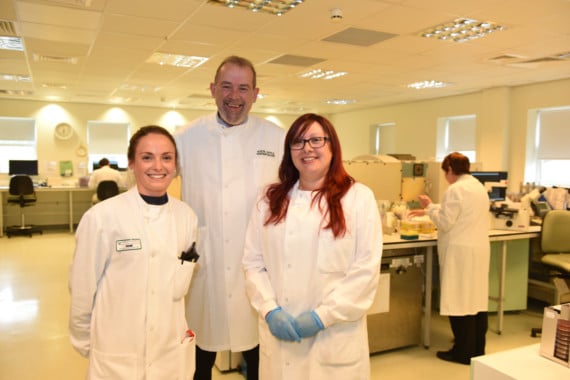
Pathology is one of the biggest departments in the hospital, employing 55 people and covering a wide range of functions. Some of their services are available 24/7 in order to assist in the treatment of acute admissions at any time of the day or night
Pathology manager Steve Doyle gave me a tour.



One of the things they are responsible for is the hospital blood transfusion service.
Steve explained: ’Like Jersey and Guernsey we bleed our own donors as well as screening and storing the blood. We also store blood products such as plasma, which can be frozen, and platelets which help to clot the blood.
’Blood can be stored for up to 35 days but platelets can only be stored for five days and will generally be bought in from the UK. We also cross match the blood to determine its suitability for each patient.
’We keep a healthy stock of blood which will cover most eventualities, including expected spikes caused by TT and MGP, and we also have in place a major incident plan for any unexpected events.’
Some of the other services provided by the pathology department are primarily diagnostic. These include haematology which analyses the cellular components of blood to diagnose blood disorders such as anaemia and leukaemia.
Haematology also undertakes analysis of the blood clotting system to diagnose conditions such as deep vein thrombosis and they monitor patients on anticoagulation drugs such as warfarin.
Then there is histopathology, which examines tissue samples and manages the cervical screening service; immunoserology, which detects antibodies and antigens in blood and provides a diagnostic service for allergy and immunological diseases, and biochemistry, which diagnoses disease which alter the body’s chemistry.
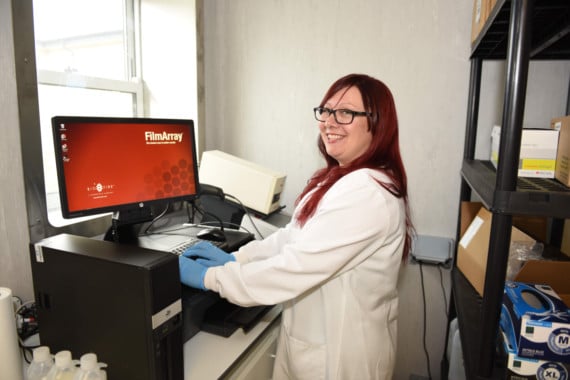
I had come specifically to see a comparatively new piece of equipment, a FilmArray machine, which was purchased for pathology by the Noble’s Hospital League of Friends.
This machine is located in the microbiology department. The unit has a tradition of giving equipment a nickname so they have named the FilmArray ’LOFTY’, which stands for ’League of Friends Thank You’.
Becky Shields, chief biomedical scientist in microbiology, gave me a tour.
Microbiology is responsible for the diagnosis of infection by the detection and identification of micro-organisms from patient samples such as blood, urine, sputum, faeces and swabs. This service is available 24/7 in order to assist in the treatment of acute admissions at any time of the day or night.
The biomedical scientists (BMS) in the microbiology lab can also determine the best type of antibiotic to treat specific infections.
This is important, not just in treating the patient but because, as everybody is aware, the overuse of antibiotics and the consequences of this for the future is a huge medical concern.
Becky said: ’We promote good antimicrobial stewardship which is the safe and effective use of antibiotics, not overuse, and we make regular presentations to all clinicians, hospital doctors and GPs, to advise them.’
Becky showed me what is their pride and joy at the moment, a FILM array machine.
It is just a tiny box connected to a computer screen but this unassuming looking machine can do amazing things.
Anyone suspected of having contracted certain serious infections, including meningitis and other forms of sepsis, will have to undergo a lumbar puncture to take fluid from their spine in order to confirm the diagnosis.
Whereas before the samples of cerebro-spinal fluid had to be sent off island to be tested, often taking several days, this machine can do it in a fraction of the time.
Biomedical scientist Craig Pownall demonstrated how simple the FilmArray is to use on a sample of cerebro-spinal fluid which had just come in from one of the wards. It’s quite a tiny sample needed, just one fifth of a millimetre, and it looks exactly like water in the test tube.
The procedure he follows to prepare it to go into the machine takes just a few minutes. Previously it would have taken hours of lab time to prepare each sample before it could then be sent away for testing.
’Now, pretty much within an hour and a half of receiving that sample we can give them a result,’ said Becky.
It not only saves crucial time and worry for patients and their families, especially when it is a young child that is sick, it also saves bed time on the wards.
Recent statistics gathered by the pathology department showed that there have already been 45 cases where the FilmArray has enabled them to rule out the possibility of the patient having meningitis.
If a meningitis diagnosis is confirmed the machine can also analyse whether it is the bacterial or viral form of the disease and which antibiotic will be best suited to treat it.
A patient brought in with suspected meningitis will, in the first instance, receive ’empiric therapy’, which is sometimes defined as a therapy begun on the basis of a clinical educated guess in the absence of complete information.
It is most often used when antibiotics are given to a person before the specific bacterium causing an infection is known. Before the arrival of the FilmArray this treatment might last for several days.
Becky said: ’Empiric therapy covers a lot of things but may not be the very best way to treat a specific infection. Now, in an hour, we can say: "It’s definitely this so absolutely the best drug for it is this" and they can get rid of the infection so much quicker.’
It is good to know this so that patients aren’t treated unnecessarily and antibiotics aren’t overused.
Another virus, enterovirus, will clear up on its own if the body is left to do the work and doesn’t need antiviral drugs at all: again, it is good to know this so that patients aren’t treated unnecessarily and antibiotics aren’t overused.
The FilmArray also assists with an accurate diagnosis of respiratory infections in children who are immuno-compromised, for example if they are suffering from leukaemia, or adult patients in intensive care.
’These are cases where a small infection can cause a big problem,’ explained Becky.
Patients and their families will probably not be aware of any of this and of how fortunate we are on the island to have this piece of equipment which lots of much larger laboratories in the UK don’t have.
Becky received a reminder of it recently during a visit from a colleague who works in the pathology department of a very large hospital in the north west of England.
He couldn’t believe that a hospital on the Isle of Man could boast such a sophisticated machine.
As you might imagine he was, from all accounts, rather envious...
Comments
This article has no comments yet. Be the first to leave a comment.