
The Manx Wildlife Trust is the leading nature conservation charity in the Isle of Man, protecting the fragile Manx wildlife by creating living landscapes, living seas and encouraging and fostering a society where nature matters.
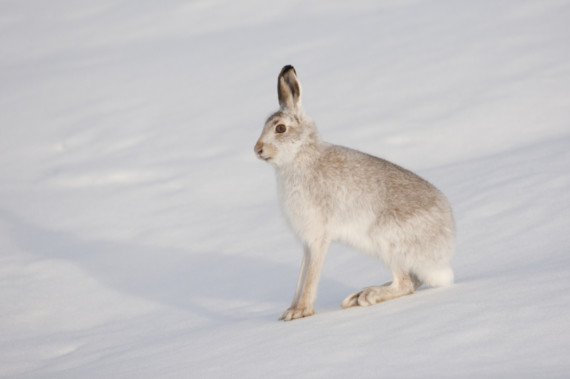
Our special challenge this month is to look out for hares, we always think of mad March hares at this time of the year and in the island we have two hares, the brown hare and the mountain hare.
It can be difficult to tell the difference between hares and rabbits, but hares are generally larger, and have longer hind legs than rabbits and longer ears.
The rabbit’s fur coat retains its colour year-round, while mountain hares change colour from greyish brown in summer to white in winter.




The brown hare is a relatively common sight, often found in hay fields and cattle grazed meadows, with its long loping gait and tall ears with their distinctive black tips easily marking them out from rabbits.
The brown hare’s awkward walking gait changes when the animal runs at speed.
Its long footed hind legs extending in front of its forelegs and giving it huge leverage and great speed over the ground.
The mountain hare is by contrast smaller and, unlike brown hares, the ears of mountain hares would not reach the tip of the nose if pulled forward. They are also a more rounded shape.
Its most distinctive characteristic is its white coat which it develops during the winter months. After the introduction of the brown hare by the Romans, mountain hares became restricted to the upland regions.
Mountain hares were re-introduced to the island and, nowadays are only found above 500m in the island. Unfortunately, global warming is likely to decrease their range.
We would welcome any sightings of mountain hares and the locality.
We are also interested in the arrival of the first chiffchaff.
Chiffchaffs are birds of woodland, scrub, parks and gardens.
Their name arises from their simple ’chiff chaff chiff chaff’ song, which they perform from the tree canopy.
Some chiffchaffs stay all year-round, but most migrate here from Africa.
They are one of our earliest arrivals, and their songs can be heard from the end of February onwards.
We want to know if their arrival dates are getting earlier or not. Look for a bird about 10cm in body length with a dull green top to the body and pale yellow below, with an off-white belly and a short eyebrow stripe.
Willow warblers and chiffchaffs are very similar, but willow warblers have pale legs, while chiffchaff legs are more of a dark grey.
Any sighting is important and we need these details: where you saw it, the date you saw it, what it was and your contact details.
If you can, take a photograph of your find as this helps us for verification purposes. You can email the information to [email protected] or phone us on 844432.
Most of all, we hope you enjoy getting out and about in our wonderful Manx countryside.
by Dawn Dickens
www.manxwt.org.uk
Comments
This article has no comments yet. Be the first to leave a comment.