
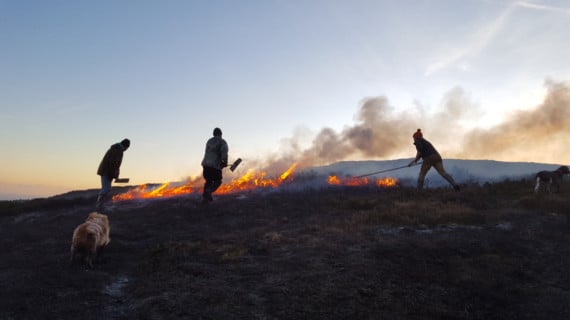
Plumes of smoke could be seen rising from South Barrule on Sunday.
It was part of efforts to manage the moorland through carefully controlled fires to burn off old heather.
The shooting tenants of the land, who carried out the fires with the support of DEFA, say their efforts help to support the small population of red grouse as well as upland species such as common snipe, jack snipe, skylarks and hares.
Dan Walker, speaking on behalf of the group, explained: ’Although we’re "shooting tenants", the reality is that we’re mostly involved in management, monitoring and conservation, as there’s a voluntary ban on grouse shooting - implemented by the various upland shooting tenancies - which has been in place since 1993.’




Managing the moorland includes burning strips of older, deeper heather on a 10- to 20- year rotation in accordance with the Heath Burning Code and the 2003 Heath Burning Act. ’It maintains a good mix of different ages of heather and other cover plants to benefit ground nesting birds - and hill tenant David Holgate’s sheep,’ Dan said.
’Fires are carefully controlled to ensure only the minimum amount of old heather is burned off and, with the Isle of Man’s recent run of wet winters, good conditions for burning are not all that common.’
He said that the cold, crisp weather the island saw on Sunday created ideal conditions to carry out the process.
’The cold ground is well insulated from the heat, meaning the heather seeds dormant in the underlying soil are in good condition for sprouting once the weather warms up in spring, providing vital nutritious fresh growth for newly hatched grouse chicks.’
Custom-made alloy flails that are light enough to carry across the hill are used to control the fires.
’They are fitted with chains under the head to rub out small bits of burning vegetation, or they can literally be used to "beat" out the fire with the aim of creating a mosaic of small patches of heather of different ages,’ he said.
The 2,500 acres of the southern hills, from which birds of prey such as peregrines, harriers, kestrels and buzzards can be seen overhead, have been managed together since the early 1980s.
Dan explained there has been a big effort to support the grouse population by managing their habitat following a serious decline in numbers in the 1980s.
’As a result, the population density on South Barrule has remained fairly constant, despite a sizeable reduction in available habitat due to the planting of Corlea plantation,’ he said.
But there remain some challenges, including habitat destruction and a lack of breeding success for curlews, a species which has been red-listed due to a drop in the UK breeding range of 50% in the last 25 years.
Comments
This article has no comments yet. Be the first to leave a comment.