
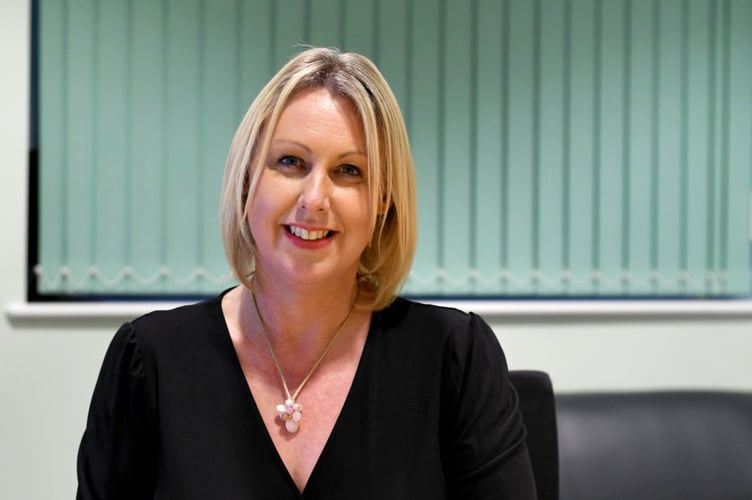
In her first newspaper interview, Manx Care chief executive officer, Teresa Cope, talks to Julie Blackburn about her radiography background, diagnosing the first two UK cases of Covid and ’The Deal’.
I love my job and a big part of that is being able to make a difference and do the role in a way which I feel is authentic - true to my preferred style and approach,’ says Teresa Cope.
Covid has changed a lot of things about the way we look at healthcare, and the way we appreciate our healthcare workers. Teresa knows this better than anybody: before coming to the island she was chief operating officer at Hull University Teaching Hospitals NHS Trust and in charge of their Covid response during the first year of the pandemic.
’In that period of time Hull had, at its peak, 230 patients in hospital with Covid, and we sadly lost three of our staff members to Covid which was incredibly hard,’ she recalls.
.jpeg?width=209&height=140&crop=209:145,smart&quality=75)

.jpg?width=209&height=140&crop=209:145,smart&quality=75)
As was the case everywhere, there was no disguising the crisis and it opened the door to an unprecedented level of communication with the public.
Teresa says: ’I was in Hull for seven years and loved my time there - it was a tough job in a health and care system which had lots of challenges, but actually people loved the NHS and how transparent we were. We very much felt appreciated and valued by the people we served.
’I can remember standing up outside Hull Royal Infirmary and doing 20-minute live broadcasts, talking about our preparations to respond to Covid. What we committed to do through the pandemic was be really honest with everybody, really transparent and the support of the population and their trust in us got us through.’
Openness and transparency is now the basis of much of how Teresa is aiming to fulfil her brief of transforming the island’s healthcare. And this means not being afraid to say things no one has ever said before.
She explains: ’I don’t want a very traditional hierarchical culture, I want to be open and as accessible as possible. I want to share as much information as possible with everybody, both internally and externally, and I want to transform services and get them right for our patients.
’That may include making some difficult decisions going forward. Our aim is to ensure our services are clinically and financially sustainable and part of this is to acknowledge where our delivery models on island are not as resilient as they need to be, or perhaps not delivering the right clinical outcomes for our patients.
’My fundamental aim is to ensure that what we do on island, we do exceptionally well, and if we can possibly do it on island safely with good outcomes then we absolutely will.
’The counter to that means that patients may travel off island for their surgery and Manx Care currently spends around £20 million of its £270 million budget on health and care services outside of the island. That may need to increase in the future; however the patients’ pathway and connectivity between ourselves would be very seamless and patients would have all of their ongoing care here.
’We know people are anxious about going off island, and we know travelling adds another burden and an anxiety to people accessing care, and we don’t want people to not access care. As we plan the future of service provision we will ensure that we take all steps to ensure our pathways of care are as smooth and seamless as possible including the logistical aspect such as travel.’
Accessing the best care might not actually mean travelling across - another legacy of Covid has been the wider use of communications technologies such as Zoom. An example of this is the way it can be brought into use as part of what Teresa describes as ’one of the real successes’ - Clatterbridge at Noble’s, which allows patients on the island to have their chemotherapy here, under the supervision of a named specialist consultant at Clatterbridge Cancer Centre.
She says: ’We firmly believe that patients who require chemotherapy can have that on island, safely, to the same standards as they would have if they’d gone to Clatterbridge Cancer Centre, using the same protocols and the same governance. Clatterbridge at Noble’s gives the assurance to our patients plus it also gives the assurance to our clinicians.
’And so, since January 2021, we’ve been progressing Clatterbridge at Noble’s and have recently signed off a business case for additional oncology nurses, cancer trackers and navigators which enables us to provide that resilient high quality oncology service here on island.’
Patients may travel across to meet their consultant face to face or they may have their initial consultation via Zoom in a dedicated suite in Noble’s Oncology Department, where will they be supported by a nurse during their virtual consultation.
Teresa says: ’That’s where we also have to have some conversations with the public so that they understand and feel comfortable that a virtual consultation is "the new norm".
’I recognise that there is a risk that you have people who just don’t engage with us, because they don’t have access to the IT and are not confident and comfortable using IT. As we move forward with our transformational plans, for a more virtual-based approach to care, we must make sure we don’t lose people along the way.’
Noble’s radiology department is another good example of delivering excellence on island. The team there has worked closely with local charities who have helped purchase state-of-the art equipment for them. Manx Breast Cancer Support along with Mannin Cancers raised the funds to buy two CT scanners and the Henry Bloom Noble Healthcare Trust provided the funds for a new MRI scanner.
Teresa says: ’I think that’s a real strength of the island: our relationship with the charities and the wider voluntary and community sector, how much fundraising does take place and how they contribute to excellent equipment and facilities for the island. This, along with a dedicated and highly skilled clinical team, has enabled Manx Care to undertake some advanced imaging that you would normally only get in teaching hospitals.’
Teresa has not been afraid of opening a public debate, nor of opening the doors of a hospital to a wider audience. When she was working in Hull, she allowed TV crews into the emergency department to film a documentary for Channel 5.
She recalls: ’I was so frustrated that we were getting criticism for our Emergency Department performance when actually what they needed to see was the exceptional care and compassion that was being delivered, and the true context of the hospital. This was one of the biggest major trauma centres in the north as a single site, seeing around 500 patients per day and receiving up to 160 ambulances in a day.
’It was a very positive series that Channel Five did with us and it certainly raised awareness. Hull, like many large cities, has high levels of deprivation with high rates of mental health and alcohol-related issues. These are often chronically unwell patients who are accessing the ED because nothing else really exists for them. They require a lot of care and intervention which often cannot be done within the four-hour national standard.’
If you haven’t seen the programme, ’A&E After Dark’ is an excellent, hard-hitting series, showing the work of the department during the night-time shift, and it’s still available on catch-up.
Famously, the first two cases of Covid in the UK were diagnosed at Hull Royal Infirmary.
Teresa says: ’At the time we really couldn’t have anticipated what was likely to unfold over the next few months. We did the basic pandemic contingency planning but this was at the end of January [2020] when this happened. I was on call and, because we were the regional infectious diseases unit, the two cases, who had been in a hotel in York, had come to Hull to our regional Infectious Diseases ward.
’I can remember getting the call from Patrick Lilley, one of the consultants, confirming the patients were positive so I got out of bed, got dressed in the middle of the night and drove to work to meet the small team that had assembled to lead our response. We needed to shut everything down, we needed to put all the arrangements in place immediately, and at that point the machine just started. I was the gold commander for Covid across our hospitals and I chaired the strategy meetings every day.’
This experience, and the higher public profile she received during the pandemic, were ultimately responsible for bringing Teresa to the Isle of Man.
She says: ’As I ended my time in Hull I was very touched and humbled to be awarded the Lord Mayor Civic Crown award and was commended by the Lord Lieutenant for East Riding for our efforts and response to the pandemic.’
’For me, it was a bit of a career-defining moment. That was when I knew I wanted to be a chief exec because at that point I was a relatively small cog in a big wheel, in this massive health and care system. ’Yes, as chief operating officer, I had a very responsible job of running two big hospitals in Hull, but that putting your head above the parapet and becoming a public figure when you are a chief exec - I didn’t ever think that was for me.
’But because I was given the job of running Covid, on a personal level it wasn’t until then that I thought "I want to be a chief exec". I will forever be grateful to Chris Long, chief executive officer of Hull, for his faith and belief in me to lead the pandemic response.’
There are also some very good reasons why the ’top job’ on the Isle of Man was so appealing to her.
She says: ’In the UK you had to pick your sector, so you were an acute hospital chief exec, or you were a mental health chief exec, because the organisations are so big.
’My background is in radiography and acute hospitals, but I’ve also got a real passion for mental health. I’d worked at Rampton High Secure Hospital as an assistant director and been a chief operating officer of a Mental Health and Community Services organisation, so I didn’t quite know what type of an organisation I wanted to be a chief exec of.
’And then this role came up and it was just perfect. It plays to everything in my background and it gives me an opportunity to work across all sectors of health and care. Manx Care is a true Integrated Care System meaning you can effect change and transformation quite quickly because everything’s under the same umbrella organisation so it was just the perfect job for me.’
With her extensive experience, Teresa could easily have looked for a senior management role in almost any sector, so I ask her why she has stayed so long with the NHS. She doesn’t even have to think before replying:
’I couldn’t imagine working anywhere else.’
By her own admission, she was not top of the class at school.
She recalls: ’I was always mediocre at school in terms of academic achievement. Then I sort of fell into radiography but as soon as I started doing it I felt like I’d found my calling and actually I was really good at it. And I have this work ethic from my Dad, and a sense of duty, so I’ve always worked incredibly hard in whatever role I have had. I take it all really seriously and I always try to go above and beyond.’
It was this mix of ability and work ethic that saw Teresa promoted to her first senior role in radiography at 23 and just a year later saw her become the youngest lecturer on the campus at Shrivenham Military College, training undergraduate radiographers.
Teresa is married to George and they have a son, Archie, who is now 11. They have always enjoyed tremendous support from her father, also George and stepmother, Glenis, who lived nearby in the same village in Lincolnshire.
She says: ’Every day they provided that framework for me to be able to be very work-focussed and to progress my career, I’ve always had their full support and they’re very proud. But when I was offered the chief exec post on the Isle of Man I sat them down and talked to them and asked: "Is it OK if I do this?"
’For the last 10 years they’ve really helped: they have done so much for us, and the conversation was "I don’t think you need me now and I don’t think you’re going to need me for the next five years or so which gives me five years to come and do this job - but if you need me I will come back and look after you". And that is "The Deal".’
Teresa adds: ’There were lots of leaps of faith coming to the island but it has all worked out.
’I doubt I will go back to the UK NHS: this is home now.
’The executive team that I’ve appointed are incredibly talented and committed and we are a strong team. Everybody has got a real sense of purpose and a common goal and vision. We also have an amazing team of staff colleagues who I feel humbled and honoured to lead.
’Manx Care has some challenges to overcome but I feel very optimistic about the future.’
Comments
This article has no comments yet. Be the first to leave a comment.