
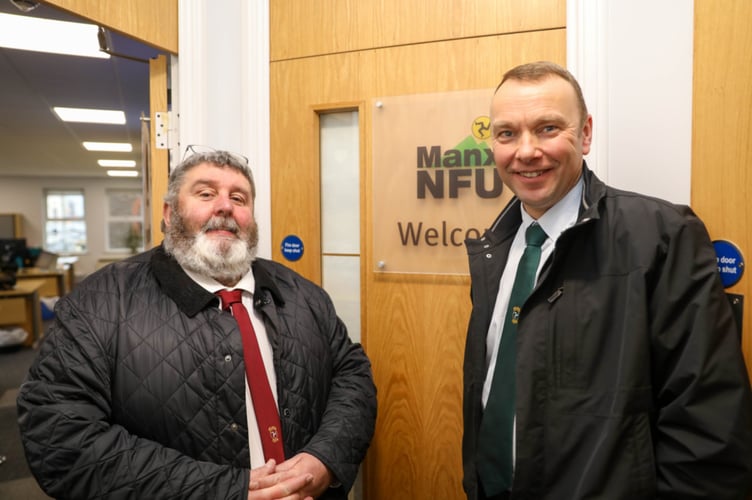
The Food and Farming page paid a visit to the Manx National Farmers’ Union for a discussion with its leaders and officials about issues concerning farmers in 2022.
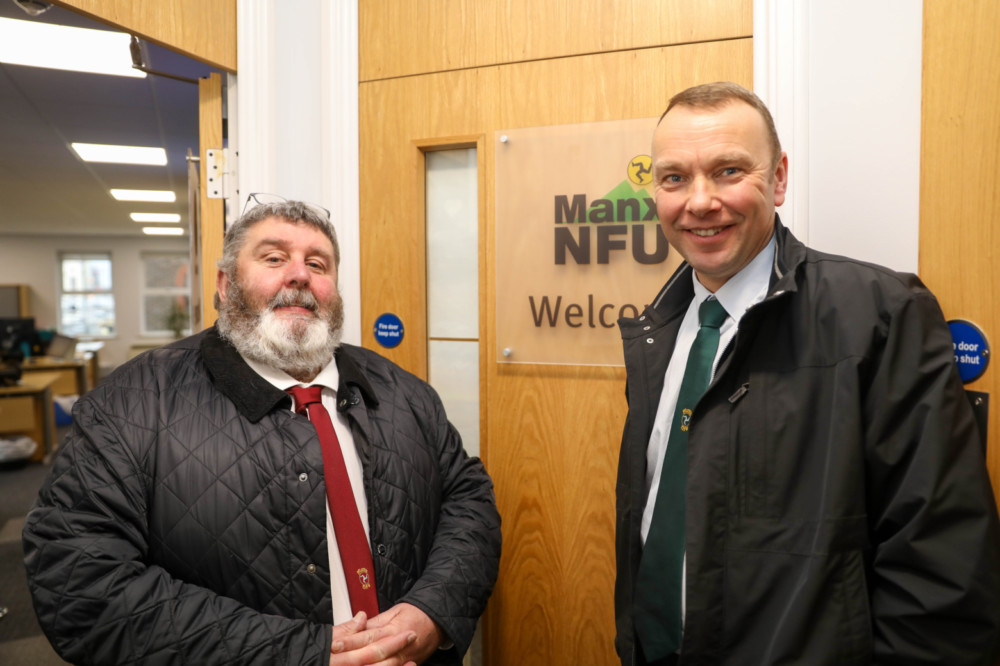
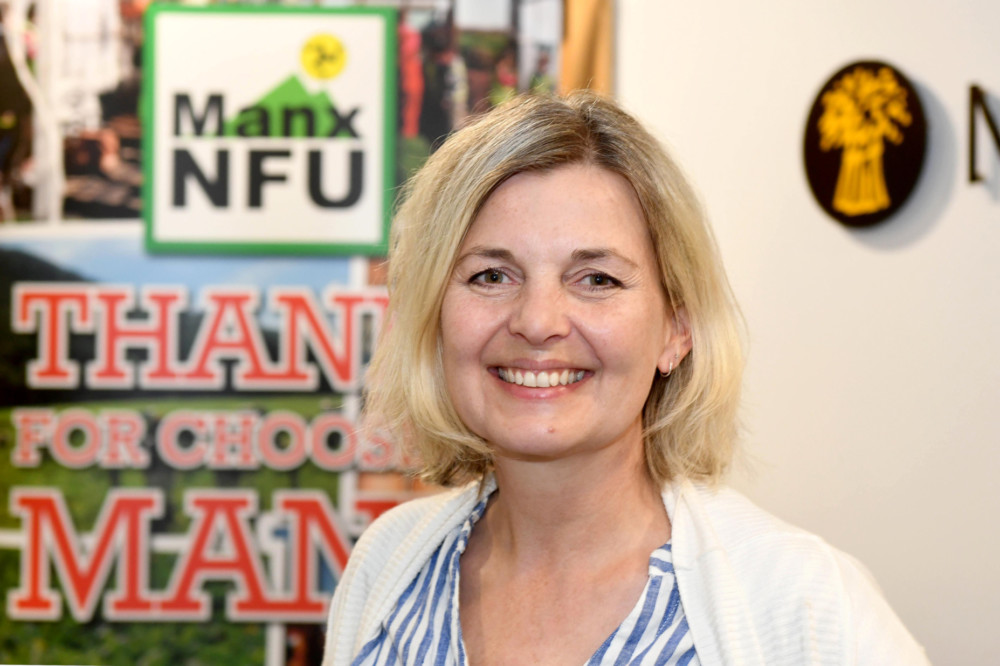
Recently elected president, Ean Parsons, and vice president, Murray Cringle, took part, along with Manx NFU general secretary, Sarah Comish, and assistant general secretary, Carolyn Lace.
Undoubtedly the two biggest issues for farmers at the moment are the new Agri Environment Scheme and the unprecedented rise in input costs.
Agri Environment Scheme (AES)
.jpeg?width=209&height=140&crop=209:145,smart&quality=75)
-with-friend.jpeg?width=209&height=140&crop=209:145,smart&quality=75)

The AES offers payment for environmental projects and initiatives carried out on farms but, at the same time, basic farm payments have been reduced. The transition to this new form of support was meant to have been brought in over three years, so that the reduction in basic payments would be gradual, but a delay in the rollout of the AES meant that it all started at once, on April 1 last year.
Since then, farmers have really engaged with the AES. Many of them have taken advantage of the environmental advice on offer from DEFA’s delivery partner for the scheme, Manx Wildlife Trust and have really tried to get on top of their brief with it. So what feedback has the union been getting about it?
Ean: ’The biggest flaw in the scheme is that we’ve gone straight to year three so the drop in payments hasn’t been graduated it’s been all of a sudden.
’And most of the payments on the AES are after the work is done so it’s had a real knock-on effect in that there’s been a sudden sharp reduction in basic farm payments and then you’ve got capital expenditure before you can recoup any payments to do with the AES.
’That’s probably been the biggest flaw and I would also suggest that the application process is overly complicated. There are 41 initiatives, each of which has got a three-page application process, followed by a claim process. But I think they [DEFA] are understanding that and we would hope that that would be streamlined.
’There are great new initiatives in the scheme that there’s a lack of skilled workforce there to help deliver: hedge laying, stone walling, hedge building. On farms we’re all pretty much running to capacity so there’s a lack of time for extra work and it’s just that skilled workforce being available to help carry out the initiatives.’
Sarah: ’Those traditional skills need maintaining: we need new people coming along, but it needs to be worth doing for them.’
Input costs
The spiralling cost of fertiliser has been caused by a spike in natural gas prices which of course is also affecting many households. The production of fertiliser is hugely reliant on natural gas, hence the price rise of around 150%. This leaves farmers with a decision as to whether they will have to cut down on the amount of fertiliser they use on their fields this year.
This is crucial as most of the island’s cattle and sheep are predominantly fed on grass, whether that be through grazing through summer months or silage and hay through the winter. Less grass will have a knock on effect on the numbers of stock farmers will keep, which will ultimately affect food prices.
It also means that farmers will be looking at various ways to be less reliant on chemical fertilisers. These include such things as making more use of slurry, which can also be more environmentally friendly.
Sarah: ’There’s a balance to be struck between changing methods for environmental benefits and the time that takes.’
Murray: ’I would argue that food prices have to go up, it’s as simple as that, and they will go up, but we can’t immediately pass that on and that’s where I can see that there’s going to be a minimum 12 months of quite severe pain [for farmers]. ’What we need to remember is that, years ago, 45% of your earned income was spent on feeding yourself and your family and now it’s about 9% and that’s an incredible reduction.’
Ean: ’Worldwide this whole globalisation is going to change isn’t it? We’ve got used to it being a global market but, going forward, there’s going to have to be taxes on transport because transportation, especially worldwide transportation, is directly responsible for an element of climate change.’
If you had to use just slurry to fertilise would you have to cut your cattle numbers?
Murray: ’I might get away with it for a year and then after that I would have to reduce numbers, just because I wouldn’t be able to produce enough grass to feed them. It would also make cropping difficult for farmers growing barley for feed.’
Ean: ’Also, if you go to the cost of getting contractors in to make silage, you need a proper crop [of grass] to make it worthwhile.
’It makes unit costs too much if you’re only growing half a crop.’
And what about the use of lime, which can be produced on the island?
Ean: ’Lime is vital. It neutralises the soil and keeps the Ph levels correct ,which allows the nutrients and utilisation of fertiliser, and allows the bacteria and everything in the soil to functions properly.
’They’re looking to push the price of that up too, by 80% so yet again it’s a massive rise in input costs.’
Avian flu
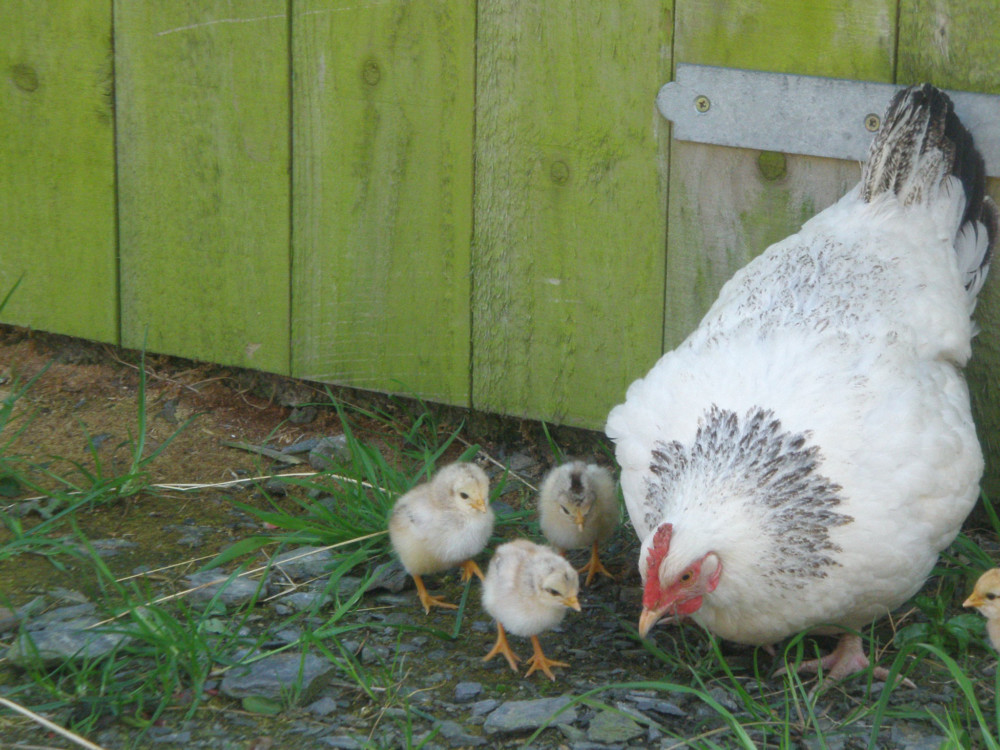
Avian flu is the latest disease to arrive on the island. It is hard to contain, as it is spread by wild birds, and the advice from DEFA is for poultry to be kept inside runs or henhouses so that they do not have contact with other avians.
Ean: ’We had a meeting in September with the new chief government vet, Amy Beckett. Before she came and joined us here her last role was dealing with outbreaks in the UK and her words to us were: "It’s when, not if".
’So, if that was the message back in September, I would like to hope that the government have all measures in place.
’You would also hope that major poultry producers would have contingency plans in place as well.’
Sarah: ’For registered poultry businesses, there are active discussions going on at the moment on how best to deal with any outbreak. At the moment there are not yet any businesses affected but what we would advise is that all poultry is on lockdown.
’You can’t stop the wild birds so it should be precautions, prevention and then notify the department as soon as you have any suspected cases at all.’
Murray: ’It’s not one to ignore.’
Ean: ’We are fortunate in that we have a qualified person to deal with it in Amy: she’s experienced it, she’s dealt with it. It’s new to all of us but it isn’t to her, so I think that will be a little bit reassuring.’
What would you both, Ean and Murray, like to achieve over your respective terms in office?
Ean: ’I suppose I’m pushing for a more profitable agricultural industry. That’s the ultimate goal. That’s a lot easier said than done but I think also our roles are going to change into trying to correct the miscommunication that comes out [in the media].
’Agriculture has become a very easy target, especially on climate change. Manx agriculture is getting labelled the same as worldwide agriculture. British agriculture is some of the most environmentally friendly agriculture in the world but the Isle of Man is a significant step better than that. We need to do more promotion of that and I think we as a union have a role, going forward, to get more data to prove it. We know that Manx farming is environmentally friendly farming and we need the data to show it. It’s no good us promoting that without having the hard facts behind us.
’But taking it right back to the profit in farming, the other part of the role as well, going forward, is stability in the process and in government policy. We’ve had a lot of change and upheaval in these last few years in Government policy and [farm planning] is a long term process.
’Cows on farms that we made breeding choices on in June last year - which female is going with which male, to produce what you want - that’s food for 2024.
’Business decisions getting made in the middle of 2021 are for the marketplace in 2024. It’s a long term industry and we need stability. Even crop rotation on arable farms: they’re tied into five, six year rotations that you can’t just chop and change and jump about.
’The other thing that’s vital is that we engage with our members - we represent them, we’re not a lone voice - and try and get them to engage as much as possible with us.’
Murray: ’I feel that we are here to represent small and big and we may not always get it right but most of the time we will and we’ll try hard. And some of my ambitions would be to get government maybe to procure more local instead of just talk about it, and for us just to work as hard as we can for the agricultural community.’
Comments
This article has no comments yet. Be the first to leave a comment.