
There have been many debates and arguments over the years about the red squirrel versus grey squirrel, with some people suggesting that the Isle of Man should introduce red squirrels into the plantations in order to save them from extinction, and others exhorting us all to ’eat a grey and save a red’.
Whatever your point of view, there’s no doubt that the grey squirrel has caused the demise of the red in the UK and that it has thrived as a species since it arrived in the UK from its native USA in the 1870s.
At what point does an animal become indigenous and subject to the wildlife laws that protect most native species?
Not only is the grey squirrel left unprotected by the UK’s wildlife legislation, it is also going to be affected by the Invasive Alien Species Order 2019 that is due to come into force at the end of this month.
-with-friend.jpeg?width=209&height=140&crop=209:145,smart&quality=75)
.jpeg?width=209&height=140&crop=209:145,smart&quality=75)
This new law will mean that a grey squirrel that is rescued, perhaps because it is injured or has because it been orphaned, will not be able to be released back into the wild legally.
It will be required to live out its life in captivity, which is something most recue centres will struggle to do both from a logistical point of view, and also from a moral one (in the belief that wild animals should not live in captivity).
While the Isle of Man doesn’t have any squirrels to worry about, we do have other non-native species that are not protected by the 1990 Wildlife Act.
Wallabies and peafowl are two such species as are the feral goats that live in the east of the island.
It is thought that the feral, or wild, goat population originates from a small private herd (of about 20 European Mountain goats) that escaped, or were released, from a private collection more than 70 years ago.
They have increased in number over the years and it is likely that they have bred with other species of goat that have been released as unwanted pets to join the herd.
The size of the current population is unknown but they are becoming a more frequent sight.
Several years ago the goats tended to stick to the rugged terrain of the cliffs around the Dhoon Glen area, but over recent years they have stared to move into Laxey, often using the railway line as their route in and out of the village.
While most residents seem to view the goats as welcome visitors, even allowing them into their houses, some don’t - and the matter seems set to divide opinion for many years to come.
The increasing goat population has led to an increase in goat-related calls to the ManxSPCA over recent weeks. We had a report of a goat being hit by a car (causing damage to the car) and we were worried that the goat would die a slow death if we couldn’t locate it.
But several days later, thanks to an observant local dog walker, we were able to confirm that the goat could walk on its injured leg, and that it had re-joined its herd.
This very same dog walker was able to cut a goat free from a wire fence last week, which is something farmers in the area do on a frequent basis.
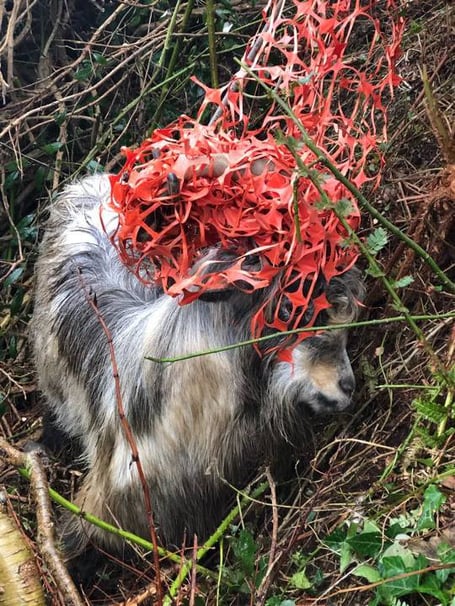
We then attended a young goat (pictured) whose horns had become well and truly tangled in plastic fencing along the railway embankment in the middle of Laxey.
It took several minutes to cut away the plastic, but shielding the goat’s eyes with a towel helped to keep it relatively calm while we snipped away. The goat then ran off without a backward glance!
We’re pleased to be able to play our part in rescuing these amazing creatures, and we would like to see them better protected by legislation.
It is worth noting that although they (and our wallabies and peafowl) are not covered by the Wildlife Act 1990, they would be coved by the island’s Cruelty to Animals Act 1997 and so this affords them some protection should they be treated in an inhumane manner.
Comments
This article has no comments yet. Be the first to leave a comment.