
Kill you speed, not a cat.
We had a truly ’black Friday’ last week, and took calls that morning about three separate black cats that were killed overnight in road traffic accidents (RTAs).
Autumn is a bad time of year for cats, as the days become shorter and our roads become more treacherous.
For many of us the daily commute to and from work is done in semi-darkness, when we’re less able to spot a cat that may be about to cross the road.
.jpeg?width=209&height=140&crop=209:145,smart&quality=75)
.png?width=209&height=140&crop=209:145,smart&quality=75)

.png?width=209&height=140&crop=209:145,smart&quality=75)
Most RTAs involving cats occur at this time of year, although the problem is a perennial one on the Isle of Man given so many of our roads don’t have speed limits (when we had the Island-wide 40mph speed limit during last year’s lockdown, we saw a dramatic decrease in RTAs).
And certain cats are more at risk than others, with young (six months to six years), male and cross-bred cats being more likely to be involved in a RTA.
Whilst it is not illegal to run over a cat and drive off, although we believe that it should be, it is basic human decency to stop the car if you suspect you may have hit one, even if you don’t like cats.
Statistically only 25% of cats are killed outright in RTAs, and many can survive if they are given immediate and appropriate care.
Sadly, we are aware that all too often cats are abandoned at the scene and left to die a needlessly slow and painful death.
A cat involved in a RTA needs to be taken straight to a vet, who will give them emergency first aid and pain relief.
You will not be charged for this because the vet has a duty of care, and is obliged by the Royal College of Veterinary Surgeons, to stabilise the cat and try to find its owner.
The best way to lift an injured cat is with one hand under its chest, supporting its chin, with the other hand placed under its hindquarters.
An old towel kept in the boot of your car comes into its own in such circumstances, and placing the cat onto a towel will make it easier to transport and less stressful for the cat.
If the cat is already dead at the very least you should move it to the side of the road so that it isn’t run over again.
The cat’s owner may well be out searching for it, and finding a relatively unscathed body at the side of the road is marginally less upsetting than trying to work out if the remains of an animal in the middle of the road are what’s left of a beloved pet.
Ideally you should take the dead cat to your nearest vet, or bring it into us at Ard Jerkyll between the hours of 8am and 5pm, where it can be scanned for a microchip.
If the owner can’t be found straight away the cat’s body will be placed into cold storage for several weeks, in the hope that an owner comes forward.
Because cats are free to roam, and accidents happen (or a cat simply gets lost and can’t find its way home) it is all the more important that they are microchipped - a simple, painless process that takes seconds.
Our cattery team are trained to microchip and can do so for a small fee of £15 (to book an appointment please call them on 851672, option 2), or you can take your cat to a vet.
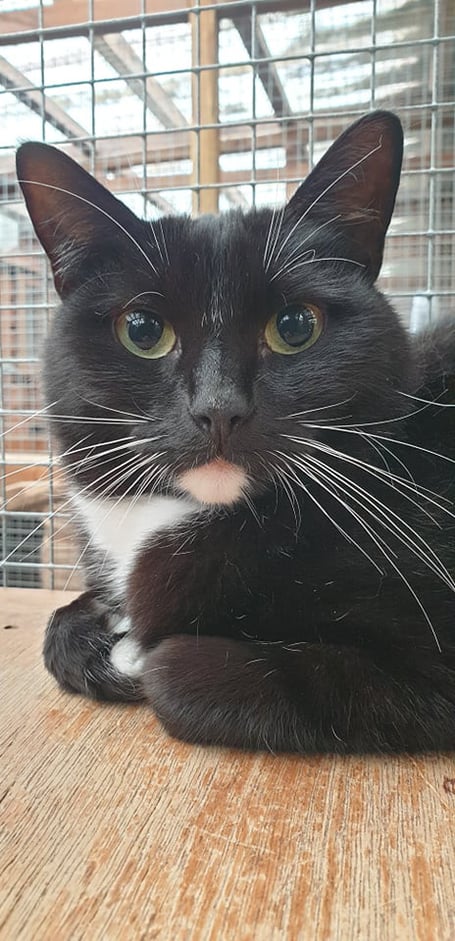
We’re hoping that our handsome, mostly black cat, Bacon lives a long and happy life once he goes to his new home, and that he has the sense not to try to cross busy roads.
He’s only three years old and he’s quite a timid boy who does not enjoy the company of other animals or children - he previously lived in a busy family home and so this is why he came to us for rehoming.
But he is affectionate with adults and he clearly enjoys human company, and so a more mature, quiet home environment would suit him best.
If you think you can offer Bacon, and other cats like him, a purrfect home please contact the cattery on the number above, and leave a message if there’s no-one there to take your call straight away.
Comments
This article has no comments yet. Be the first to leave a comment.