
Please remember that it is often better for you to take injured wildlife directly to your nearest veterinary practice.
The veterinary staff will take the animal from you for emergency treatment and you will not be charged.
For advice about how to catch, contain and transport a wild animal, with consideration for both your safety and that of the animal, please see the ’welfare’ section of our website - www.manspca.com.


.jpeg?width=209&height=140&crop=209:145,smart&quality=75)

Birds that are recovering from veterinary treatment, or ones that come to us as youngsters, spend time in our aviary and it is getting fuller by the day as is to be expected at this time of year.
Some of the very young birds need to be fed by hand at regular intervals throughout the day.
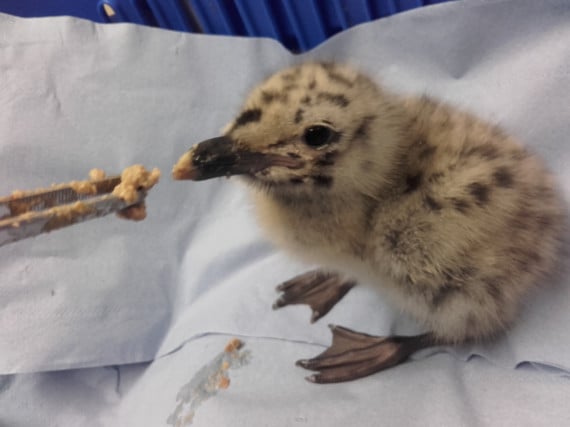
The herring gull chick, pictured, came to us from Ramsey having fallen out of his nest.
He is particularly fond of fish-flavoured cat food and makes a very loud squawking noise when he’s hungry.
Some people class herring gulls as ’vermin’ not least because they can be aggressive towards humans when they are protecting their young and, as anyone trying to eat an ice-cream on Peel Promenade will testify, they will dive-bomb remorselessly in order to steal food.
But because these super-intelligent birds are such efficient scavengers, eating pretty much anything, they help to keep our towns and beaches clean.
You might think that herring gulls are everywhere and that there are too many of them.
However, the species is declining significantly across the UK with its population having decreased by 50% in 25 years.
In 2009, the RSPB placed the European herring gull on its ’red list’ of threatened bird species, affording it the highest possible conservation status.
The decline in fish stocks caused by over-fishing is the most likely reason for the decline in numbers and, in turn, this drives the gulls to seek new food sources which can bring them into conflict with humans.
Closer to home, Manx Birdlife have confirmed the herring gull’s decline in their latest seabird census - full details can be seen on their website http://manxbirdlife.im/seabirdcensus2017-18/.
Their findings show that there has been an 87% decline in herring gull sightings around our coast over a 20-year period. The Isle of Man Examiner reported details of the survey on May 28.
There is hope that this decline can be halted. The Isle of Man now has ten marine nature reserves (MNRs) that stretch around most of its coastline.
These areas offer protection to the species and habitats that surround our shores by restricting fishing and other activities such as the removal of sand or gravel.
Creating a better ecosystem will improve fish stocks which, in turn, should help our seabirds.
Loss of nesting sites is also cited as a cause of the decline of many of our seabirds, and so please be patient when you have a nest on your roof or in your chimney stack.
The parent birds are very protective of their young and can behave in quite an aggressive manner towards us humans, and any unwary cats and dogs that pass by. But this aggressive behaviour is short-lived, and only lasts until the young gulls have fledged.
Don’t forget that fledglings of gulls, and many other bird species, need to spend some time on the ground while their flight feathers develop. The parent birds will be watching over them and so please don’t assume that the fledglings need to be rescued. Watch and wait.
We think our little chick deserves the right to life, and we will do everything we can to get him to the point where he can be released back into the wild in a few weeks’ time.
Comments
This article has no comments yet. Be the first to leave a comment.