
Reptiles should not be regarded as low-maintenance, child-friendly pets.
They require breed-specific husbandry, appropriate handling, and many need a diet that involves feeding them live insects.
However, reptiles can be very rewarding and engaging if an owner is prepared to invest time and energy into their care.
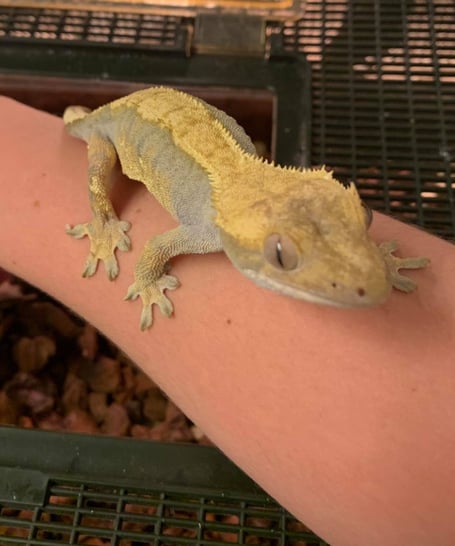
We are looking for a knowledgeable and experienced person to adopt three crested geckos that were brought into our small animals unit last week.




We’re not sure of their ages, but a new owner needs to be prepared for them to live for 15 years or more.
Crested geckos were thought to be extinct for many years until they were rediscovered in 1994 in New Caledonia, a small island east of Australia.
Their Latin name is Correlophus ciliatus - Correlophus is the genus or type of gecko, and ciliatus translates as ’having eyelashes’ which refers to the hair-like projections found above the animal’s eyes.
They really are very sweet creatures both to look at and by nature - they need to be handled gently, and they are responsive to touch.
They can become easily stressed, and this causes tail loss.
Indeed, two of our three geckos do not have tails and, unlike some species of gecko, they won’t grow back.
They don’t seem to be bothered by a lack of tail, but we are concerned that they may have an underlying health issue.
This makes an appropriate diet all the more essential.
Crested geckos are omnivorous and like a diet of fruit and insects (ideally live crickets) and they should be fed at night because they are nocturnal.
They should also be provided with a bowl of fresh water, but they prefer to lick condensation from their surroundings and from their own bodies which means that daily water spraying, or misting, in the vivarium is essential.
A suitable vivarium is as important as a good diet and humidity, and needs have a mesh top for ventilation and to be tall because the crested geckos enjoy climbing and jumping.
Their wild cousins are rainforest dwellers and so captive animals need branches, faux or live plants and foliage, and perches in their vivarium.
They also need to be able to hide, and coco fibre mats are a good choice of floor covering because the geckos can burrow under them.
The vivarium will also need special lighting, which should be on for 10 to 12 hours a day to promote good metabolism and bone growth; and if the ambient room temperature is cold then the geckos will need a heat lamp.
These little creatures learn to recognise their owners and can provide lots of interactive enjoyment, but if you prefer your pets to be cute AND cuddly then a cat or kitten may be a better choice.
We are well and truly in to ’kitten season’ and our isolation and quarantine unit is full of young felines who are undergoing health checks.
Once they are fully vaccinated they are moved up to our main cattery and placed for adoption.
Kittens are always in demand and if you would like to adopt one, or two, it is essential that you complete a home finder questionnaire, which you can find on the adoption pages of our website, so that you can join the waiting list. Most kittens are too small to neuter or spay while they are with us and so they are rehomed with a voucher that the new owner can then use to pay for the procedure to be done, once the kitten is large enough.
Whether it’s geckos or kittens always do your research before you commit to pet ownership, and chose an animal that suits your lifestyle and domestic circumstances.Tai
Comments
This article has no comments yet. Be the first to leave a comment.