
Animals are helping in the fight back against Covid-19 in more ways than one.
A new Belgian study reports that antibodies obtained from llama blood can help neutralise the virus responsible for Covid-19, and they could prove to be useful therapeutics during future outbreaks.
An accidental discovery in a Brussel university laboratory in 1989 highlighted the unusual properties of antibodies found in the blood of camels, llamas and alpaca - all members of the camelid family.
These antibodies were originally used in HIV research and more recently they have proved effective in combating a wide range of viruses including Middle East respiratory syndrome (MERS) and severe acute respiratory syndrome (SARS).



.jpeg?width=209&height=140&crop=209:145,smart&quality=75)
The camelid antibodies are much smaller than human ones and so they target viruses more effectively in what is now referred to as nanobody technology.
Putting aside the ethical debate over using animals in scientific experiments, ferrets have been used for some time in biomedical research, particularly in the study of human influenza.
A recent South Korean study reported that ferrets infected with Covid-19 responded very similarly to humans, and they could have a part to play in the development of antiviral treatments and preventative vaccines.
Closer to home, a UK charity called Medical Detection Dogs (MDD) has begun training canines to sniff out Covid-19, and is lobbying the British government for funding to train as many dogs as possible.
The medical detection dogs work in a similar way to the dogs that we see at our ports and airports, sniffing for drugs and explosives.
MDD has spent the last 12 years training its dogs to detect various cancers and diseases such as malaria and Parkinson’s, and it started working on the Covid-19 project last month.
Its dogs are being intensively trained to sniff out samples of the virus, and when they indicate that they have found it they receive a treat. The approach is based on a belief that each disease triggers a distinct odour which dogs are uniquely adept at smelling due to their sophisticated olfactory senses.
The charity believes that it can help to screen hundreds of people for Covid-19 very rapidly, and in a non-invasive manner, identifying who then needs to be formally tested and quarantined.
The London School of Hygiene and Tropical Medicine is backing the initiative, and believes that MDD dogs could revolutionise our approach to the pandemic.
The dogs could be trained in as little as six to eight weeks, and it is likely that their initial deployment will be at airports.
Heathrow, for example, has been heavily criticised over the past few days for allowing passengers to disembark from international flights and simply head for home without any form of Covid-19 testing.
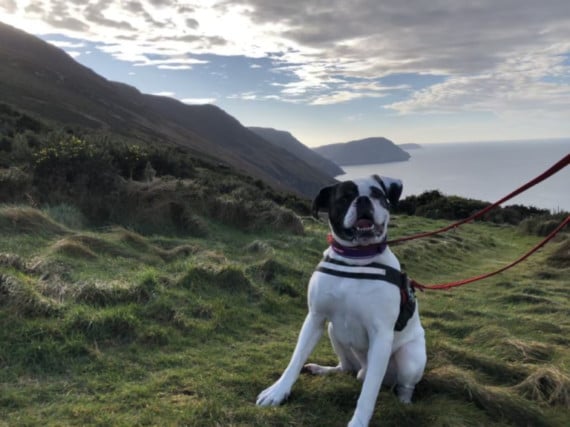
Dodger may not be cut out for life as a medical detection dog, but he enjoys scent games and sniffing out treats. He’s only three years old and so he has lots of energy to play games and have fun.
The kennels team describe him as a big, loveable oaf because he’s so laid back and affectionate, but he can be a bit ’bouncy’ and over-excited around other dogs
Given he’s an American bulldog and weighs several stone, this exuberance will need to be something his new owners take into consideration.
If you would like to find out more about Dodger, please call the kennels team in 851672, option one, and leave a message if they can’t get to the phone straight away.
Comments
This article has no comments yet. Be the first to leave a comment.