
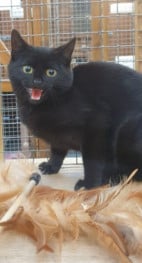
If you love cats then you won’t be surprised that they have some incredible natural features that make them extra special, with one of these being their mouths.
For example:
- A cat’s jaws can’t move from side to side like a human’s, and can only move up and down.
This makes it difficult for them to grind and chew their food, which is why they tear at larger chunks to make them more digestible, and swallow smaller pieces of food, like cat biscuits, whole.
.jpeg?width=209&height=140&crop=209:145,smart&quality=75)


- Rather than scoop water into their mouths like dogs do, cats lap at it by moving their tongues very quickly to create a column of water.
They then quickly close their mouths around the column and swallow the water without getting their chin or their whiskers wet.
- Not only are cats able to drink without splashing their faces, they are adept at keeping their whole bodies clean. Their tongues are covered in tiny, curved spines which give them a rough texture.
These spines work both as a comb, untangling knots and smoothing fur, and they are also able to carry large amounts of saliva from the mouth to the fur allowing for any unwanted dirt to be washed away with ease.
Being fastidious about keeping clean is mainly due to a cat’s survival instincts - the cleaner the cat, the less smell they emit and so they are less able to be tracked and killed. This also works when they are tracking their own prey - an undetected, fragrance-free cat will be more successful when out hunting.
- Cats can’t taste sweet flavours, even though they have sophisticated taste buds.
They simply don’t have the receptors in their brains to recognise a sweet taste. They are, however, much better at detecting bitter tastes, as this helps them identify foods that could be poisonous.
- Cats are born with an amazing number of teeth in such tiny mouths.
Kittens have 26 baby teeth which fall out when they are about three months old and are they are replaced with 30 permanent adult teeth (compared to humans who are usually born toothless, and then develop 20 baby teeth and 32 adult teeth).
- Due to their low-sugar diet, differences in mouth bacteria and the shape of their teeth, cats don’t get cavities in the same way that humans do.
But they can suffer from other dental issues, most commonly gum disease, which are usually due to an inappropriate diet.
A cat’s teeth are designed to crunch bones and a modern diet of soft cat food isn’t ideal.
Sweet five-month-old Sersi has beautiful shiny white teeth, as you can see, and is a talkative and chatty young thing.
She was brought into us as a stray from St John’s, and so we don’t know much about her background, but she clearly didn’t have much human contact in her early life.
The cattery team and volunteers have spent lots of time with her and she is getting more and more confident by the day. Her ideal home will be a quiet one with experienced cat owners who can spend lots of time with her and continue to build her trust.
Sersi has not yet been spayed (she’s not far off, but she is still a bit too small) and so she will go to her adoptive home, when she finds one, with a neutering voucher which will cover all the costs of her operation.
She is fully vaccinated and microchipped and so her adoption fee of £75 is value for money.
And you can’t put a price on the feeling you get when you adopt an animal rather than buy one - ’rescue’ really should be everyone’s favourite breed.
Comments
This article has no comments yet. Be the first to leave a comment.