
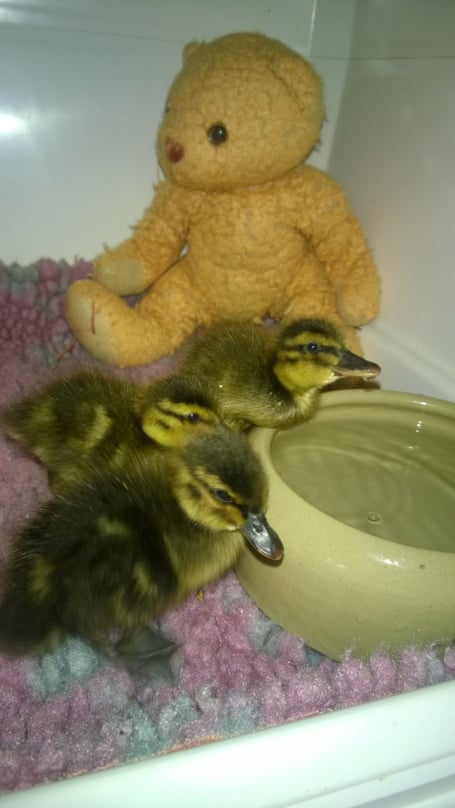
Baby bird season is now upon us, and we have started to see a variety of youngsters coming into our aviary.
Ducklings are usually the first species to start hatching, and this year is running true to form with three separate ’braces’ of them being brought to Ard Jerkyll in the last few days.
One of the collective nouns for a group of ducks that are in the water is a ’paddling’.
Very young ducklings need to be supervised when they swim, which they can do from day one of hatching, but once they are a few days old they can have access to a bowl of water at all times.



-(2).jpeg?width=209&height=140&crop=209:145,smart&quality=75)
Our ducklings are kept in heated ’brooding boxes’ until they are old enough to be moved to the outdoor aviary pens where they can develop their swimming skills in large water troughs before being released back into the wild.
Ducklings do well when they are reared in captivity, not least because they are fairly self-sufficient as soon as they hatch, but other species of bird are more of a challenge because they need regular hand-feeding.
Members of staff take these birds home with them so that they can be fed from dawn until dusk, as they would have been by their parents, and we are given invaluable support by the Manx Wild Bird Rehabers to help us to do this.
The Rehabers are usually able to take the smaller birds from us (sparrows, robins, blackbirds, etc), and get them to a point where they can go into an outdoor aviary before being released.
The majority of phone calls we receive at this time of year relate to baby birds, with callers concerned about the birds’ welfare and safety.
There are some rules of thumb that generally apply: if the bird is injured it will need veterinary attention; and if it doesn’t have feathers it needs to come to the ManxSPCA for hand rearing in conjunction with the Rehabers.
However, if the bird is uninjured and has feathers, and it is able to hop or run, then it is a fledgling and it should be left alone.
Fledglings are almost always being watched over by their parents, and they need a couple of days on the ground for their flight feathers to develop properly.
Some callers are worried that a fledgling might fall prey to cats, or wander onto a busy road, and if the danger is a real one then the bird will need to be handled and moved as a last resort.
It is vital that the parents should still be able to see and hear their offspring, and so it needs to be placed out of danger but near to where it was found.
An option is to place the fledgling into a bucket, lined with a towel, and then to suspend the bucket from a washing line or equivalent - out of the reach of cats but accessible to the parent birds.
One of the commonest reasons why people don’t like cats is because of their hunting instincts and the fact that they kill so many garden birds. We have a solution for someone who wants a cat but who also wants to enjoy garden birds in close proximity, and she is called Wilma - she needs to be an indoor cat, or at least have limited access to the outdoors, because of an old spinal injury that affects her movement and makes her a bit lopsided.
We’re not sure how she was injured because she came to us as a stray, but she isn’t in pain and she is very happy to be picked up and fused over. She is approximately eight years old and is a very attractive light tabby colour, with big green eyes.
Over in the kennels we have a variety of breeds, ages, shapes and sizes of dogs looking for new homes and the staff have been busy over the Easter holidays talking to prospective adopters and making appropriate matches.
But Spike, the four-year-old Shar Pei, has not yet found a new home. We think this is due to the fact that he is quite reserved and apprehensive when he meets new people, and his personality takes time to emerge.
However, he is responding well to training and gradually gaining in confidence, and he will need a new owner who has the patience and commitment to continue with this programme.
Comments
We've recently changed our login process. If you have an account for commenting, you will need to re-register on the login window.
This article has no comments yet. Be the first to leave a comment.