
The Manx Wildlife Trust is the leading nature conservation charity on the Isle of Man, protecting the fragile Manx wildlife by creating living landscapes, living seas and encouraging and fostering a society where nature matters.
Now more than ever we need you, the citizen scientist, as extra eyes and ears reporting back on how our wildlife is doing.
This month we are keen to find out the first sightings of the Orange Tip and the Holly Blue butterfly.
The male Orange Tip is a medium-sized white butterfly with an orange tip to its wing and is easy to spot.


.png?width=209&height=140&crop=209:145,smart&quality=75)

However, the female is easily confused with small whites and to tell the difference you really need to catch a glimpse of the underside of the wing, as both male and female have mottled green underwings.
Holly Blue butterflies have bright blue wings, with the females having black edges to their wings.
The wing undersides are pale blue with small black spots which look like they have had pepper sneezed on them.
It is this key feature which distinguishes them from common blue butterflies.
The Holly Blue emerges well before other blue butterflies and you can spot it flying high around bushes and trees.
It is the commonest blue found in gardens and can been seen on holly in the spring and ivy in late summer.
Butterflies are extremely valuable indicators of the state of the environment and they help us monitor biodiversity.
If their numbers decrease it tells us also about their larval plants and nectaring plants for the adults.
They are highly-sensitive indicators of the health of the environment and play crucial roles in the food chain as well as being pollinators of plants.
So, we are very eager to keep a track on what is happening to our population.
We appreciate that there is limited access to the countryside currently, but if your garden is near to damp fields and verges with cuckoo flowers then you are likely to see them.
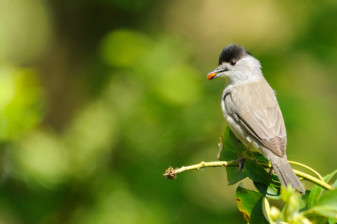
We are also keen to find out about the Blackcap, a member of the ’warbler’ family of birds.
They used to migrate every winter to the UK from Germany but there is an increasing trend of them becoming resident.
One of the reasons is the fact we feed birds, meaning they can find the food they need constantly all year around.
The Blackcap is a grey-coloured warbler, with a black cap for the males, hence the name, and a chestnut-coloured one for the female.
Blackcaps are feisty at bird feeders and tables, often chasing away other birds. You can also listen out for its delightful song which has earned it the name ’northern nightingale’.
Why not listen to it online then see if you can hear it outside?
Please when you submit any sightings to the Manx Wildlife Trust, remembering to include the date, species seen, where you saw it and your name and a contact details in case of queries.
Photographs are always a bonus too.
Email them to us at [email protected] or phone 844432.
Our records are passed to the NBN Atlas Isle of Man which anyone can access.
by Dawn Dickens
Biodiversity education officer
www.mwtrust.org.uk
Comments
This article has no comments yet. Be the first to leave a comment.