
The Manx Wildlife Trust is the island’s leading nature charity, owning nature reserves, surveying the wildlife and keeping an eye on the challenges which face our island wildlife today.
Feeling a bit frazzled in the sunshine? Why not head into the dappled shade of our glens and woods to go exploring for ferns?
Ferns are one of the earliest vascular plants, which have cells which transport water and food around them, that developed on earth over 300 million years ago.
They are non-flowering plants that mainly reproduce by spores, and belong to the Pteridophyta group of plants. Most ferns have large, divided leaves which have spores clustered on the underside of them.

.jpeg?width=209&height=140&crop=209:145,smart&quality=75)
.jpeg?width=209&height=140&crop=209:145,smart&quality=75)
Most ferns love the shade and are often found in woodlands.
Our most common fern, bracken, grows at a rapid rate and can out compete other plants and dominate an area, which is why it often needs to be managed. On heathland it provides cover for many ground nesting birds
So how do you identify a fern? It is important to note how the leaves are divided, do the lobes (pinnates) join the line running up the centre of the stem, known as the mid rib, opposite each other or not?
What colour are the stems and what colour are the spores on the underside of the leaves? Size is helpful too.
Ferns are remarkably adaptable and grow in uplands, woodlands and minute versions on walls all around the island.
We have the delights of the mountain fern, which when the fronds are squeezed gives off a lemony fragrance.
So head off down to the woods or search your nearest wall to discover what fern delights are growing there.
You can help to support our work by joining the Manx Wildlife Trust. Details can be found on our Facebook page, or at manxwt.org.uk
Harts Tongue fern
Unlike the other ferns on this page, the Harts tongue fern has an undivided leaf, which has a glossy sheen and is shaped like a very long and narrow spear head.
The bright-green fern prefers shaded conditions, and fronds can grow up to two foot high in woodlands. On exposed walls, they may only reach two to three inches and have a more faded, yellow colour.
If you look on the underside of the leaves, you can see that the spores are arranged in parallel lines.
Look for it in our Onchan wetlands reserve.
Royal Fern
This is easily our tallest fern at up to six foot high, and it is also one of our most attractive ferns. It turns a glorious bronze and golden colour in autumn.
The royal fern sends up tall spears with spores on which give the appearance of fluffy flower spikes during June and July. It grows in damp and boggy woodlands, so a trip to the Ballaugh Curraghs or our Close Sartfield reserve will enable you to spot them.
This picture shows the Royal fern resplendent in all it’s autumnal glory at the Curraghs. It is a must see around September to October.
Hard Fern
This is also known as deer fern and grows about 40cm high. Interestingly only the upright fronds will have spores on, the fronds lying horizontally do not bear any. They grow in the acid rich soils in shady areas of our woodlands, and the pinnate edges curly under.
The fronds have pinnates spaced along the midrib in a comb like way, touch the leaves and instead of the softer feel like harts tongue the fronds are tough and leathery feeling. This fern is common and widespread around the island.
Common Polypody
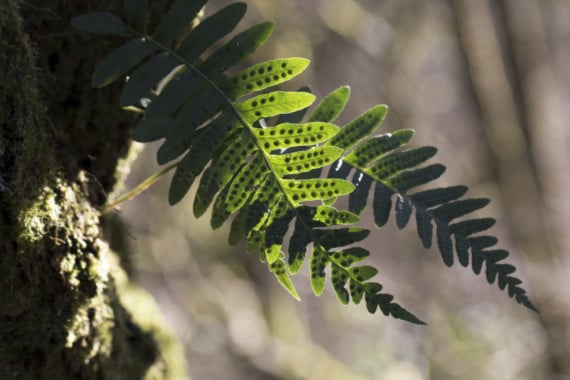
This is one of our smaller ferns, with the pinnates being staggered in a herring bone fashion up the midrib. Follow the frond downwards and you will find it comes up from a rhizome which is covered in scales. The spores on the underside are round and change to an orange colour as they mature.
Growing on rocks and walls, you can also find some high up in the trees in some of our wetter glens, such as glen Elfin. It contains a substance 500 times sweeter than sugar, but it’s not recommended to eat any as it has laxative properties!
Comments
This article has no comments yet. Be the first to leave a comment.