
The Manx Wildlife Trust is the leading nature conservation charity in the Isle of Man.
It protects the fragile local wildlife by creating living landscapes, living seas and encouraging and fostering a society where nature matters.
Last month’s request for information about silverfish elicited an enthusiastic response and it would seem that silverfish are out there and thriving!
This month is ideal to try and spot the dark green fritillary butterflies.


.jpeg?width=209&height=140&crop=209:145,smart&quality=75)
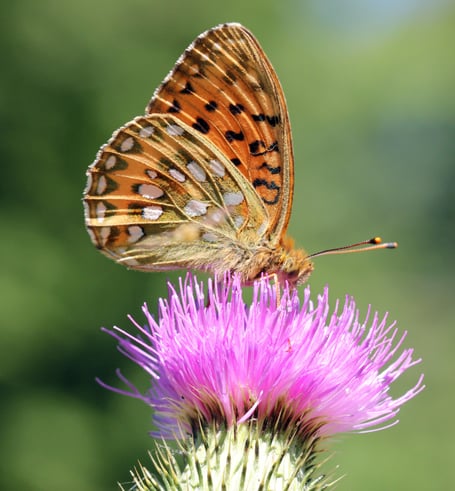
This particular butterfly is a species that is harder to find and we are especially interested in the Ayres, where this species has better footing, and also the south of the island where they fly over coastal grassland areas, feeding on knapweed and thistle nectar. The top side of the wings are orange coloured with black spots and a black border to them.
It’s the hind wing underside of this butterfly which gives rise to its name, as they have a greenish hue with silvery coloured spots.
The caterpillars feed on violets which grow more abundantly in areas with light grazing by sheep and cattle, which keep the grass down.
The peak time to see dark green fritillaries flying is in late June to early July.
Look for them in the early morning and early evening on thistles, brambles and clover, as they flit constantly from flower to flower to feed.
With these butterflies being so quick at feeding, an easier way to spot them is to sit and wait near a likely patch of flowering thistles and knapweed.
It is common practice in the butterfly world for the males to patrol set areas.
A male green fritillary’s approach is to flit and glide over a likely habitat site and drop down to investigate any brown-looking object.
The female dark green fritillary has one batch of eggs a year which are laid on vegetation near to the larval food plant of violets.
After two to three weeks the larvae emerge from the eggs.
Butterfly caterpillars have one purpose and that is to eat.
This is the only life-cycle stage during which growth in size takes place.
This growth requires regular moulting of the exoskeleton by the caterpillar and in all six stages, known as instars, are gone through, the last instar caterpillar is black with tufts of hair along its back and distinctive orange spots along the side.
This butterfly over winters in its larval state.
The larvae then create a pupa which is burnt brown in colour.
The wing cases can be clearly seen and its abdomen is bent double at the end of the pupal case, giving it a very strange appearance.
After three to four weeks that incredible miracle of transformation takes place and an adult butterfly will emerge.
We need your help to send us in sightings of this butterfly which will then be passed onto NBN Atlas Isle of Man and other interested parties.
Send the location and date you saw the butterfly, along with contact details in case of queries to [email protected]
Photos are always a bonus too. When trying to photograph butterflies, the top tips are not to let your shadow fall over them, try a cooler part of the day, don’t wear strong scents, move very slowly, wait by their food plant and have lots and lots of patience! Good luck and keep sending us your photos and sightings. Thank you all for your help.
If you would like help to identify wildlife on your walk, or even want to set out on a walk with a goal, then why not take one of our island-specific spotting sheets? Download them from manxwt.org.uk under the headings ’discover-our-island’ and ’stuck-home’.
by Dawn Dickens
Biodiversity education officer
www.manxwt.org.uk
Comments
This article has no comments yet. Be the first to leave a comment.