
We do our best to attend to welfare calls as quickly as possible, but road closures (in particular, the Foxdale Road one) mean that our response times can be longer.
Please remember that it is often better for you to take injured wildlife directly to your nearest veterinary practice.
The veterinary staff will take the animal from you for treatment and you will not be charged.

.jpeg?width=209&height=140&crop=209:145,smart&quality=75)
.jpeg?width=209&height=140&crop=209:145,smart&quality=75)
.jpeg?width=209&height=140&crop=209:145,smart&quality=75)
For advice about how to catch, contain and transport a wild animal, with consideration for both your safety and that of the animal, please see the ’welfare’ section of our website - www.manxspca.com.
Birds that are recovering from veterinary treatment, or ones that come to us as youngsters, spend time in our aviary and it is getting fuller by the day as is to be expected at this time of year.
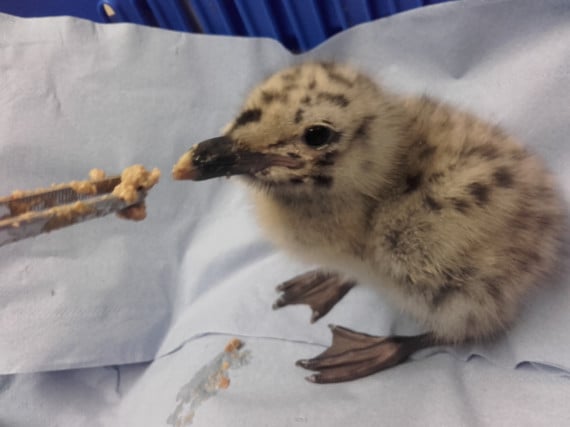
Some of the very young birds need to be fed by hand at regular intervals throughout the day. The herring gull chick, pictured, came to us from Ramsey having fallen out of his nest. He is particularly fond of fish flavoured cat food and makes a very loud squawking noise when he’s hungry.
Some people class herring gulls as ’vermin’, not least because they can be aggressive towards humans when they are protecting their young, and, as anyone trying to eat an ice-cream on Peel Promenade will testify, they will dive-bomb remorselessly in order to steal food.
But because these super-intelligent birds are such efficient scavengers, eating pretty much anything, they help to keep our towns and beaches clean.
You might think that herring gulls are everywhere, and that there are too many of them.
However, the species, when taken as a whole, is declining significantly across the UK with its population having decreased by 50 per cent in 25 years.
In 2009, the RSPB placed the European herring gull on its ’Red List’ of threatened bird species, affording it the highest possible conservation status.
The decline in fish stocks caused by over-fishing is the most likely reason for the decline in numbers and, in turn, this drives the gulls to seek new food sources which can bring them into conflict with humans.
We think our little chick deserves the right to life, and we will do everything we can to get him to the point where he can be released back into the wild.
Bullmastiffs are also much maligned, not least because their stocky build and reputation as good guard dogs create the perception that they are aggressive.
Aggression is not a breed trait, and in fact bullmastiffs are renowned for their sensitivity and friendliness towards humans.
Ty, a fawn and white bullmastiff cross, came into the kennels last week because his owners are expecting a baby and they simply don’t have time for him.
He’s only 12 months old, and he is incredibly bouncy and playful. He can become boisterous if he doesn’t get enough attention, and he will respond well to further training to help manage his ’over enthusiasm’. He has lived with older children, but he can react to dogs he doesn’t know, especially if they are on a lead, and this can be problematic given he is so strong. Again, further training will help with this.
The kennels staff are on-hand to give plenty of advice and ongoing support to adopters, and to help introduce a rescue dog to an existing family dog. This is often done in one of the exercise fields, away from the hustle and bustle of the main kennels, where dogs can be given the opportunity to be off the lead and create their own space.
Ty doesn’t enjoy a kennels environment and reacted badly to being in a boarding kennels elsewhere on the island last year, and so we would like to find his new family as quickly as possible. Please come and meet him.
Comments
This article has no comments yet. Be the first to leave a comment.