
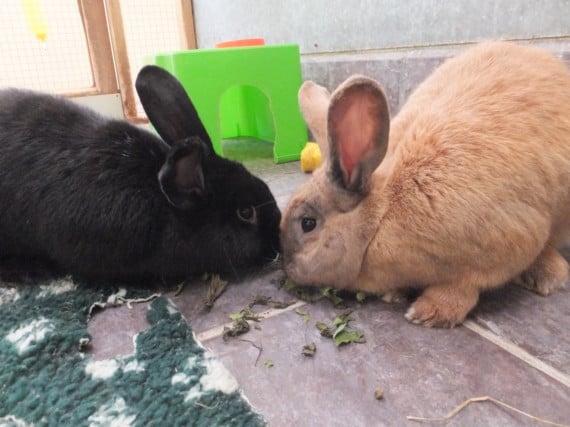
More and more people are keeping rabbits as house (or flat) pets, rather than outside in a hutch.
House rabbits often live longer lives than outdoor bunnies - up to 12 years in some cases - and so the argument for keeping your rabbit indoors is a strong one.
The ideal scenario would be for a pet rabbit (or rather rabbits, plural, because they should be kept in pairs) to have access to the outdoors in a large run, and to be able to come indoors when it suits.
But this isn’t a practical arrangement for some households.


.jpg?width=209&height=140&crop=209:145,smart&quality=75)
Rabbits are sociable animals, which is why they make such great companions, and keeping them inside the home can make it easier to spend time with them.
Ideally they should be given free range in a large part of your house or flat, and this means you will have to rabbit-proof the rooms they have access to. They are prolific chewers and they are particularly partial to electrical cords which can be rabbit-proofed by being placed in cable ’tidies’ and plastic tubes. Indoor rabbits should be provided with toys that they can chew on such as cardboard boxes, wooden blocks and twigs, and this will lessen the likelihood of them nibbling on cables and furniture.
Rabbits are naturally very clean animals and most are relatively easy to litter train, but they may try to eat regular cat litter (made of clay or wood pellets) and so a paper-based one is best. They will need a place to sleep in and so they should be provided with an indoor hutch with plenty of hay for bedding. They will also graze on the hay, as they would do on grass. Their other dietary requirements are relatively simple and they will need specialist rabbit pellets, fresh vegetables and a bowl of fresh water.
Some vegetables, though, are not good for bunnies including iceberg lettuces, potatoes, cauliflowers and rhubarb.
If you are considering a house (or flat) pet then we have the ideal rabbits for you - Shadow and Thumper.
They are one-year old Flemish Giants and so, as large rabbits, they will need plenty of space to run around in. They are both litter trained and so they could live indoors from day one.
We also have several pairs of rabbits who would be happier living outdoors, not least Casper and Roo who have been with us for almost six months despite being adorable. They have lived with children before and so they will make a great family pet.
All of our rabbits are vaccinated against RHD and myxomatosis, which are the most prevalent and deadly rabbit diseases that can affect both domestic and wild bunnies.
Across the UK there has been a decline in the number of wild rabbits, but the causes for this are not clear.
A UK charity, the Mammal Society, is trying to gather better data about wild rabbits so that it can evaluate the decline in numbers (which is thought to be as high as 60% in some areas).
The Mammal Society is concerned that the more abundant species, like rabbits, are taken for granted and so it is urging people to download an ’app’ that will enable them to record rabbit sightings (please go to www.mammal.org.uk for more information).
Although some people regard wild rabbits as pests, their role in the eco-system and food chain is massively important and a better understanding of their distribution and numbers will inform any future conservation efforts.
Comments
This article has no comments yet. Be the first to leave a comment.