
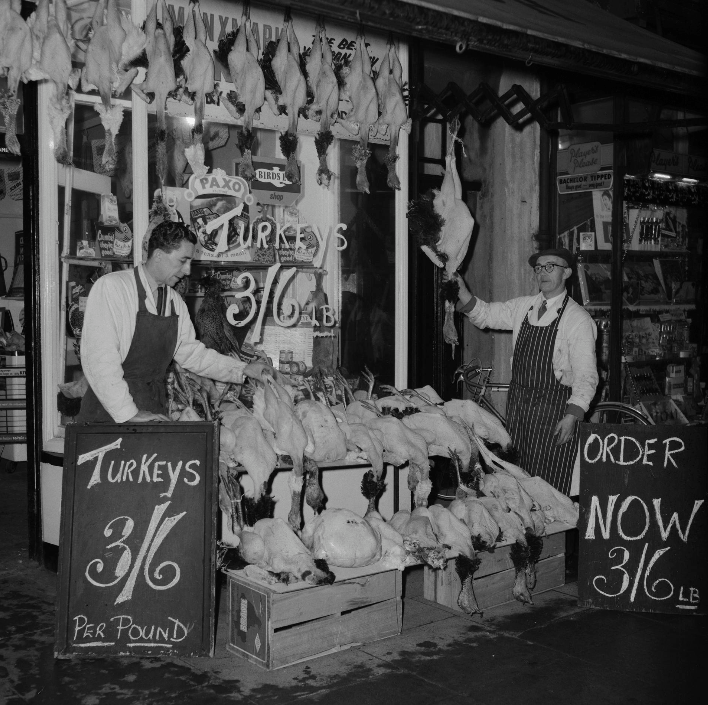
Another look at Christmas past this week. How about Christmas fayre over the years as a starter?
Before the 1950s, Christmas meals were about seasonal, local food and, of course, celebration.
Roast goose or turkey, ham or beef; seasonal root vegetables, bread sauces and gravy; Christmas pudding, mince pies and fruitcake. Drinks included mulled wine, punch, ale, sherry and port.
After rationing ended in the UK in 1954, turkey became firmly established again as the Christmas centrepiece, with bread sauce, sage and onion stuffing and one of my favourites, Brussels sprouts.
.jpeg?width=209&height=140&crop=209:145,smart&quality=75)

.png?width=209&height=140&crop=209:145,smart&quality=75)
Christmas pudding, mince pies and trifle followed, and of course canned fruits and vegetables, which were seen as modern and convenient.
My dad was a family grocer on the North Quay, and I remember, as a special treat, canned strawberries.
Drink-wise, sherry was popular, along with port and brandy, punch, and of course tea remained central to Christmas gatherings.
In the 1960s, convenience and ‘modern living’ were predominant, with frozen turkeys and vegetables.
What about a prawn cocktail starter? Still something I enjoy.
Sausage rolls and cocktail sausages followed, cheese boards became more common, and for pudding? Jelly-based desserts and trifles. For drinks, Babycham — remember the cute deer on the bottles and glasses?
For Nanna, a ‘must have’ was the Snowball (advocaat and lemonade), producing a distinctive yellow treat. Reminder needed here… don’t eat yellow snow!
In the 1970s, turkey remained the dominant feature. Who remembers all the ‘bootiful’ ads for Bernard Matthews?
He started his business in 1950 in Norfolk with only 20 turkey eggs, and by 1971 his company went public when it was listed on the stock exchange.
People enjoyed gammon and glazed hams, vol-au-vents, pâté and quiche, and for afters, Black Forest gâteau or yule logs.
To wash it down, wines became more popular - remember Blue Nun and Mateus Rosé?
Cream liqueurs emerged, and for the party set, cocktails became more of a thing.
For those who enjoyed bitter or mild, competition from lager became more intense.
The 1980s, in line with how some revelled in ‘loads of money’, were a decade of ‘more is more’, with larger multi-course meals featuring smoked salmon and prawns, and ‘exotic fruits’ such as kiwi, mango and pineapple.
There was a move towards buffet-style Christmas parties and large chocolate selection boxes - more about them later!
For drinks, champagne and sparkling wines became more popular. Do you like Champagne (if you can afford it)? I have very rarely, and I am not an enthusiast.
Baileys, which had been launched in 1974, was huge by the 1980s and still is.
For a Christmas spirit - no, not that type - whisky and vodka were popular.
In the 1990s, some people started questioning excess and tradition, with alternatives such as duck, goose and beef rib becoming popular, along with the emergence of vegetarian nut roasts.
There were lighter starters and fewer courses. Panettone and continental desserts were gaining ground, and supermarkets stocked a range of ready-made Christmas foods.
To drink, Prosecco and lighter wines were popular, and speciality beers emerged.
It is really good to see the award-winning Manx offerings in this area of the market today.
After meals, espresso and cappuccino were enjoyed. I can honestly say I have never had an espresso - my coffee of choice is a latte (milky coffee!).
Another trend was the availability of reduced-alcohol options.
How about the 2000s? Supermarkets stocked fully prepared Christmas dinners; Asian and Mediterranean influences were available, along with tapas-type sharing plates, sushi (something else I have never eaten!), antipasti and spiced side dishes.
For pudding, alternatives included cheesecakes and tortes. For a tipple, flavoured vodkas, premium bottled beers and a revival of the mulled wine tradition became popular.
The 2010s saw food choices becoming more values-driven, with vegan and vegetarian mains, free-range and organic turkeys, gluten-free and allergy-aware baking, and artisanal cheeses.
How well has the Isle of Man Creamery done under Findlay Macleod’s direction - and before this latest trend?
Sold all over the world, with a superb and award-winning choice. Charcuterie became a Christmas addition for many.
For those who enjoy desserts, homemade rustic styles were popular. Your drink?
Craft beers and small-batch spirits - another area where producers on our island were successful.
Natural and organic wines followed, and who could miss the gin boom, especially flavoured varieties? Non-alcoholic festive drinks increased in popularity.
Finally, the 2020s apparently brought smaller meals, including plant-based alternatives; nostalgic dishes with modern presentation; and grazing boards instead of formal dinners for some.
Well done to all those who came up with leftover alternatives to reduce food waste! The alcohol-free trend continued with wines and spirits.
Who doesn’t love a premium hot chocolate or spiced latte? Festive coffees and a number of classic cocktails were revived.
And me? Well, I’m a prawn cocktail, full Christmas turkey dinner (with sprouts and cranberry a must), Christmas pudding with custard, lots of homemade mince pies - some with brandy butter - Manx cheese, one or two Morettis and maybe a sparkling wine… then a snooze! How about you?
How about Christmas treats? Who had heard of ‘shrinkflation’ before the last 20 years or so?
In 2011, Quality Street and some other boxes, tins or tubs were around 1kg; this year they are 550g.
It is suggested by some that the number of individual chocolates inside the container has fallen by half, whilst prices have roughly doubled.
Not only that, but upon opening your Quality Street (or others, which I still enjoy, even though I shouldn’t), the former started to change in 2022 from the loved and familiar foil/plastic jewel-coloured wrappers to dull, paper-based wrappers.
The official line is that this was driven primarily by environmental and sustainability concerns rather than cost-cutting or branding redesign.
According to the brand owner, Nestlé, this was the first time in 86 years since the launch of Quality Street in 1936 that the iconic bright wrappers were replaced with a different material.
From 2023 onward, most of the twist-wrapped sweets inside tubs came with the new paper wrappers (coated paper rather than shiny foil, plastic or cellophane).
The driver behind the shift was part of an initiative to reduce non-recyclable wrapper waste.
Quality Street aimed to keep ‘two billion wrappers a year out of landfill’.
For decades, the original wrappers were a signature of the Quality Street identity.
Many consumers associated opening the tin - the bright wrappers reflecting the tree lights - with nostalgia and festive tradition.
According to a ‘chocolate historian’ (no, not me - I’m just a lifelong consumer!), the original 1936 launch intentionally emphasised ‘an explosion of colour, different flavours, different shapes’, with the wrappers playing a key role.
In other news, if you get a chance, tune into Manx Radio on Tuesday (December 23) between 7.05pm and 9pm, when I get together with my old friend Chris Williams for our annual Cave Christmas Party.
Then on Christmas Eve, between 6.05pm and 8pm, they are letting me loose on my own again for a 1970s Christmas show.
I hope you have a merry Christmas! Thanks for all the feedback each week; it is always interesting to read, from near or far.