
The World Health Organisation officially classifies hoarding as a medical disorder.
About 1.2 million UK households are affected and, although hoarding tendencies are often associated with older people, the disorder can be found across all ages, genders, education levels and ethnicities. Hoarding in relation to animals is not uncommon.
Most people collect something at various points in their lives but Hoarding Disorder involves excessive behaviours, and it is often linked to other mental health issues such as Obsessive Compulsive Disorder.
Little is known about the cause of Hoarding Disorder - it may be genetic and run in families, or it may be linked to a traumatic life event experienced by a sufferer earlier in their life.
.png?width=209&height=140&crop=209:145,smart&quality=75)
.jpeg?width=209&height=140&crop=209:145,smart&quality=75)
-(1).jpeg?width=209&height=140&crop=209:145,smart&quality=75)
A person with Hoarding Disorder who hoards animals will usually have rescued them (or believe that they have rescued them), have a great attachment to the animals, and they will not be able to recognise that they have too many.
They will downplay the fact that they cannot provide appropriate care and husbandry, and be oblivious to the deplorable conditions both they and their animals are living in.
Because they love their animals they often end up emotionally overwhelmed, socially isolated and alienated from family and friends who cannot understand their need to ’collect’ animals.
The island’s social services have asked the ManxSPCA for help on several occasions in recent years in relation to hoarding.
This has involved various types of animals including horses, dogs, rabbits and birds, but the most commonly hoarded animal seems to be the cat.
Most cats in this situation are un-neutered, which exacerbates the problem because cats can breed from just four months of age and they will mate with their brothers, sisters and parents.
Females can have more than one litter a year, and just one un-neutered female can be responsible for 20,000 descendants over a five-year period.
And, as if that isn’t bad enough, an un-neutered male will be prone to fighting, thus spreading a deadly cat disease called Feline Immunodeficiency Virus, and will urinate and spray around as much as he can to mark his territory.
If you think you need help with an over abundance of cats, or you know someone in this situation, you can call our cattery team on 851672, option 2.
They won’t judge or ask difficult questions, and will simply want to help.
If some or all of the cats are difficult to catch, perhaps because they are not used to being handled or they are semi-feral, the team will use humane cat traps.
Once the cats are brought back to the cattery quarantine unit they are immediately health checked, treated for worms and fleas and booked in for a neuter or a spay.
The cattery staff and volunteers will then spend time with the cats, so that they get used to human company and are easier to rehome.
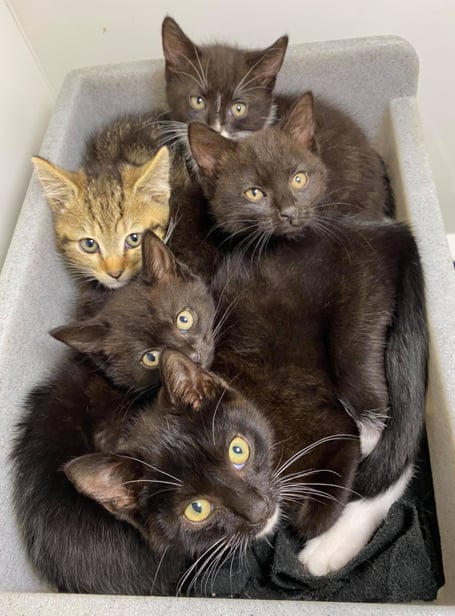
Gjon, Tix, Efendi, Roxen and Manizha all came in together as semi-feral kittens from Crosby, and they are almost ready to be adopted, ideally in pairs or in a home with another cat.
But where did they get their names from?
Well, they are all derived from Eurovision Song Contest entries with Manizha, for example, being the Russian contestant.
The kittens are not yet big enough to be neutered/spayed and so they will be sent to their new homes with a voucher which their new owners can use to have the procedure carried out, in a month or so, free of charge at Milan vets.
They will also be fully vaccinated and microchipped.
Comments
This article has no comments yet. Be the first to leave a comment.