
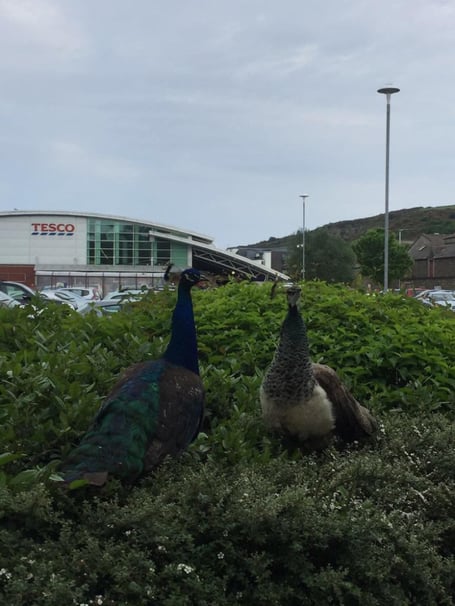
We have received more calls about this peacock and his partner than any other animal this year.
It’s not surprising, really, because exotic birds are the last thing you expect to see in a busy supermarket car park.
The birds have also been spotted in nearby locations in Douglas such as Leigh Terrace, and they are obviously very mobile, but why they would choose to live in an urban environment rather than the surrounding mature woodland is hard to understand.
They seem completely unfazed by people, and happily eat insects from the bushes and preen themselves, and hop onto stationary cars as and when it suits them (peafowl are notorious for liking to sit on cars).



We have tried to relocate them to a more rural environment but they have evaded capture and fly off as soon as a net appears.
Callers have been concerned that the birds may be run over by passing traffic and wonder whether they have been reported missing from a private collection, and some local residents have been kept awake or woken up by the birds’ screeching.
This raises the controversial issue of wing clipping, and whether the owners of peafowl (or any other ’free-range’ bird for that matter) should trim their birds’ flight feathers to prevent them from straying.
Some say that restricting a bird’s natural movement and ability to fly is cruel, and could endanger them if they unable to flee from a predator such as a dog.
Others argue that it’s better and safer to keep the bird in one place.
Having the correct environment for peafowl is the best solution, with plenty of food and roosting spaces and the company of other peafowl.
Ideally the area should be enclosed, and have overhead netting.
If you are considering wing clipping please ask you vet’s advice first - there are lots of videos on the internet showing you how to do it, but if it is done incorrectly it can cause the bird a great deal of pain.
If you have the right environment and are interested in rehoming peafowl, please contact Jane Gregory on [email protected] or by calling her on 851672.
Jane also has several (very handsome) cockerels to rehome and would love to hear from you if you have the space for these birds.
Birds adapt well to the warm weather that we’re lucky to have had recently, provided they have shade and water, but some animals need more help than others.
Brachycephalic dogs, those with shortened noses and flatter faces such as French bulldogs and pugs, are particularly susceptible to heat because their airways are restricted and they are not able to lose body heat effectively through panting (don’t forget that dogs can’t sweat).
Never leave your dog in a car in warm weather, even for just a few minutes with the windows open, because the temperature can soar in seconds. Think twice before you take your dog on a trip - even if they don’t like being left at home. You can give them something a bit different to play with, as a distraction, such as vegetables or dog treats frozen in ice cubes or ice blocks (or a ’Kong’ if you have one). A
nd you can make the ice more tasty by mixing the water with a meat or vegetable stock before you freeze it.
A paddling pool in the back garden is another great way to keep your dog cool, and great fun.
But just one word of warning - never use ice cubes or very cold water to cool down a dog (or any other animal) that you suspect is suffering from heatstroke (the shock could kill them). Make sure they have tepid water to drink and take them straight to a vet.
Comments
This article has no comments yet. Be the first to leave a comment.