
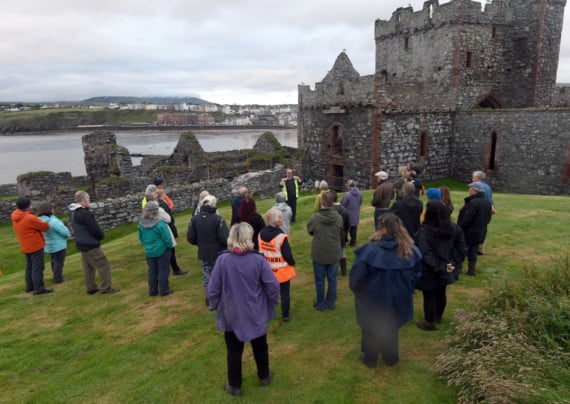
After spending much of his career investigating the remains of one of the most dramatic and imposing medieval fortifications anywhere in the British Isles, archaeologist Andrew Johnson admits that he still finds Peel Castle endlessly fascinating.
Andrew led a guided walk and talk around the interior of the castle grounds to members of Peel Heritage Trust last week and he was able to draw on his years of knowledge and experience of excavations and investigations above and below the grounds.
The large castle and medieval curtain wall has stood on the rocky islet of St Patrick’s Isle for hundreds of years.
Before the earliest buildings were constructed, the island was home to an early monastic colony plus large and important settlements from the Bronze Age and Iron Age, marking thousands of years of near-constant habitation. Most of this has left its mark on the landscape around the isle.
 Minister hints at change of heart on planned Isle of Man minimum wage hike
 Minister apologises over confusion as Isle of Man schools shut amid icy conditions
 Chief Minister reaffirms government's commitment to Isle of Man e-gaming sector
 Meet the teen who ran 68 miles through snow and ice to raise money for charity
Andrew began the talk at the gatehouse of the castle and spelt out how the doorway was built in the position that it was, explaining that before the causeway joining St Patrick’s Isle to Peel Hill was built, the River Neb would have naturally flowed through where Fenella Beach is now. The movement of water created a large natural sandbank in the direction of where the doorway faces, enabling people to walk dry-foot to the castle at low tides.
The talk moved to the insides of St German’s Cathedral, where he spoke about the conservation that was currently being carried out on some of the external and internal walls.
He was able to point out areas where stone work was replaced during restoration work carried out during the 1880s by the conservation architect Andrew Robertson, which contrasted with the original weathered sandstone from hundreds of years ago.
He then revealed that the large-scale excavation work carried out in the 1980s was informed by an initial desire to see whether or not it was possible to re-roof the cathedral. ’It’s a question I am always asked: "Why won’t you put a new roof on the cathedral?",’ he said.
’There was actually work carried out in the late 70s to see what state the walls and ground were in and whether they could actually build another roof.
’They quickly found that the walls were unsuitable for such a thing, but what they found led to the 1980s excavations.’
Andrew cut his archeological teeth on these digs and the finds he helped to excavate and record changed and increased much of what was known about the castle’s history.
An Iron Age grain store was found, Bronze Age artefacts and even Neolithic pottery and axe heads came out of the ground.
Most thrilling of all was to be walked to the site of a large cemetery, of which only a small fraction was excavated.
Digging through a two-metre wide trench, Andrew spelt out how the found thousands of bodies, haphazardly buried and rearranged through the ages, before finding, at the bottom, some well-preserved stone lintel graves, one of which contained the famous ’Pagan Lady’.
’We know so much from that one trench, but we are sure that it is only a fraction of the bodies still buried under the ground here still.’
The talk finished with a examination of the oldest buildings on St Patrick’s Isle, the round tower and St Patrick’s Chapel, which was held in the light of a spectacular sunset.
’As an archaeological student, to work on this site and find evidence that pointed to the fact that it is so rich and contained such valuable information, and also to have it right on your doorstep in the town where you grew up seeing it every day, is just incredible,’ he said.
’No matter how many times I look at the castle, dig through the grounds, investigate the walls or walk around the buildings, I always find something new about the place and I expect that with the works going on now, we’ll find even more.’
Comments
This article has no comments yet. Be the first to leave a comment.