
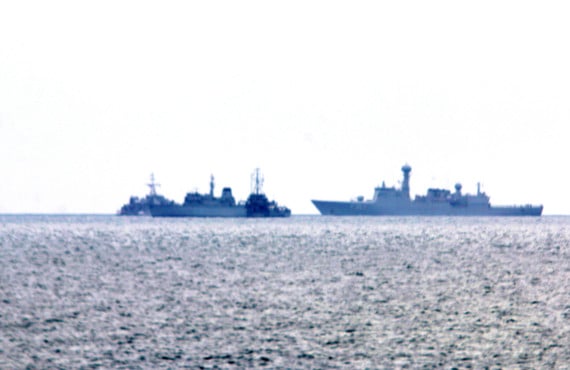
Fort Island, defended from foreign invasion since the time of Henry VIII, was witness to a naval incursion as Nato ships carried out manoeuvres in Manx waters.
Planned amphibious landings on Langness, as part of a large military exercise code-named Joint Warrior, have been shelved following an environmental impact assessment.
But this week four Navy vessels - British, Danish, German and Norwegian - were spotted carrying out manoeuvres off the peninsula.
The lead ship was F357 HDMS Thetlis, a Danish Navy ocean patrol vessel, followed by M31 HMS Cattistock, a Hunt-class mine countermeasures vessel of the British Royal Navy, M1065 FGS Dillgen, a German Navy minehunter, and HNoMS Hinnøy M343, an Oksøy class minehunter of the Royal Norwegian Navy.




Biannual and multi-national Joint Warrior is the biggest military exercise in Europe and has in previous years included up to 13,000 troops from British, Nato and other allied armed forces.
It is taking place between the end of this month and April 11 in the North Channel and Irish Sea and waters to the north, south west and west of the Hebrides.
There had been plans to have an amphibious landing on the Isle of Man, in an area believed to be in the Langness peninsula/Castletown Golf Links area, much of which is a Site of Special Scientific Interest (SSSI).
This has sparked concerns from the Mannin branch of the Celtic League over the impact on wildlife.
An impact assessment ordered by the Navy said that ’once onshore, troops must minimise the disturbance to any nesting birds on cliffs/beaches’ and spill plan procedures had to be in place to ’minimise the risk of pollution during landing operations’.
But in a statement, a Royal Navy spokesman confirmed: ’We have already withdrawn our request to conduct training on the Isle of Man as part of Exercise Joint Warrior.’
Comments
This article has no comments yet. Be the first to leave a comment.