
It happened right out of the blue.
Two friends who keep their horses with us were down in one of our fields when one of them was bitten by a horsefly and, within minutes, was experiencing a severe allergic reaction.
I went down to help and an ambulance was called but it was a hard location to describe down a lane that’s more of a footpath, through one field and into another.
It didn’t matter: the operator who took the 999 call was able to pinpoint our location immediately and exactly.
.jpeg?width=209&height=140&crop=209:145,smart&quality=75)

.jpeg?width=209&height=140&crop=209:145,smart&quality=75)
I have since discovered that this was down to an app called ’what3words’.
It is based on a simple but clever idea: to divide the world into three-metre squares and give each one a unique three-word address.
In an emergency, identifying a caller’s exact location is crucial. But, especially in a more remote rural location, it can be hard to describe.
A farmer trying to guide the emergency services to a specific field, an area of a riverbank or a location up a hillside could find it quite challenging.
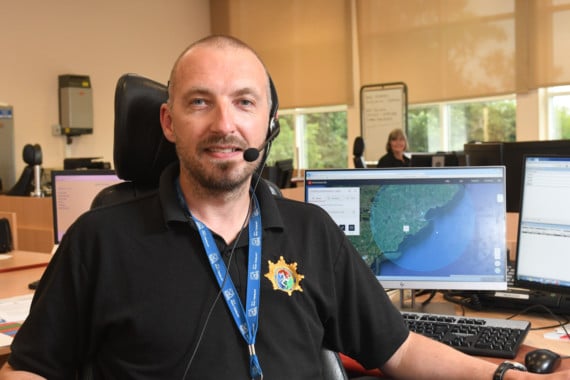
Phil Bell-Scott, a supervisor in the Emergency Services Joint Control Room (ESJCR) near police headquarters, says: ’I can recall a job last year. A chap found an injured sheep and we needed to contact the farmer. It was in a really complicated area somewhere near Santon Gorge and we got it using what3words and we were able to pass the three words on to the farmer who could download the app himself and guide himself to the scene.’
Each set of three words used is unique and quite random, and bears no relation to any of the words for the adjacent squares.
To illustrate it, Phil brings up another recent case where a walker had fallen on Bradda Head and sustained a suspected broken ankle: ’On this occasion they used what3words and those words in this case were "treatable.head.skiwear".’
The nearby landmark of Milner Tower meant that this would not have been a hard location to describe but Phil goes on: ’There’s another instance here where there’s an outside fire in a field that was being given as "in the vicinity of Marine Drive".
’Being in a field, the actual field that it’s in, and the access to the fire crews, is important and What3words pinpointed it.’
When he shows me the location on a map on his screen, this particular field would have been almost impossible to describe.
’We can guide the crews in because we know exactly where it is now, the exact position.
The accuracy is to within a three-metre by three metre square and the whole process only takes about a minute,’ he says.
The app can be even more useful for visitors and holidaymakers who don’t know their way around the island at all and some local holiday accommodation owners use it to help their guests locate them.
It also works the other way round, as Phil explains: ’We do occasionally get calls here from the UK because when you ring 999 that number works everywhere in the UK - it basically routes through the nearest mast that’s available and then routes to the control room that covers that area, but sometimes they’ve got a better signal from here than they have in their local area.
’I’ve had a fatal accident call from the east coast of Ireland, we’ve had plenty of calls from the likes of the Isle of Whithorn and once from people who were lost in Hardknott Pass in Cumbria.
’Years ago it was difficult to find them if they didn’t have the GPS co-ordinates and they were trying to explain where they were in an area we don’t know. We’ve always found them of course but it used to take longer than it should do.’
And what about my friend with the horsefly bite?
The same procedure was followed as with all emergency calls concerning a medical emergency. Once the operator had located the caller and dispatched an ambulance, he stayed on the phone talking to her and going through a set list of questions to learn more about the exact nature of the illness or injury.
Questions included: ’Is she completely alert’ and ’Is she having difficulty breathing?’
The answers in my friend’s case indicated anaphylactic shock. This can be so dangerous that it is a Category One response, their highest priority, and an ambulance arrived within minutes.
The paramedics were able to give her a timely dose of anti-histamine before she was taken to hospital.
Happily she soon recovered and now has a supply of Epipens for the future but it couldn’t have been a clearer demonstration of how useful what3words can be in a potentially life-threatening situation.
l The what3words app is free to download.
Comments
This article has no comments yet. Be the first to leave a comment.