
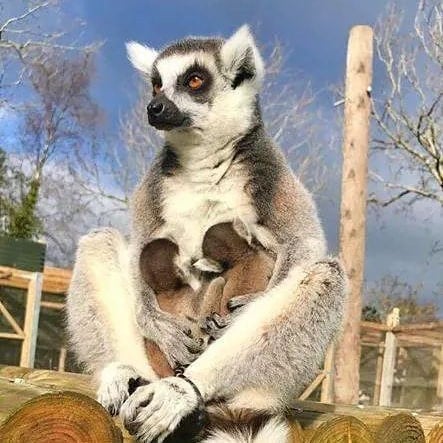
Curraghs Wildlife Park has welcomed twin additions to the ring-tailed lemur family.
The newborns arrived on March 25 and are yet to be named as their sexes are unknown to park staff, who do not want to disturb them while they bond with their mother Acorn.
For the first three to four weeks of their lives, the babies will cling to their mother’s belly before switching to Acorn’s back.
’Then they will start exploring for themselves and will be jumping and bouncing around, which is lovely to see,’ Kathleen Graham, general manager of the park, said.
.JPG?width=209&height=140&crop=209:145,smart&quality=75)



Acorn is one of the top dogs of the group - now increased to eight lemurs - as her mother is the leader.
’She has her mother’s protection,’ she added. ’So there will be no baby pinching or a risk of them being dropped from a height.’
She added: ’It isn’t uncommon to have twin ring-tailed lemurs, but it is more common to have twins in captivity than in the wild. That’s because of the resources available in zoos.
’The number of ring-tailed lemurs have really plummeted in the wild. It’s thought that 90% of the population is to have disappeared in recent years. There are more ring-tailed lemurs in parks than in Madagascar.
’Lemurs have been particularly poached. Fragmentation conflict with man seems to be the problem and that’s why there is focus on conservation efforts.’
She added that ’there needs to be focus’ on ring-tailed lemurs as more effort tends to be placed on other endangered lemurs in Madagascar, which pushes the species closer to the brink of being critically endangered.
Ring-tailed lemurs were not affected by the fire that tragically took place in 2018, claiming the lives of gentle lemurs at the Ballaugh park.
Comments
This article has no comments yet. Be the first to leave a comment.