

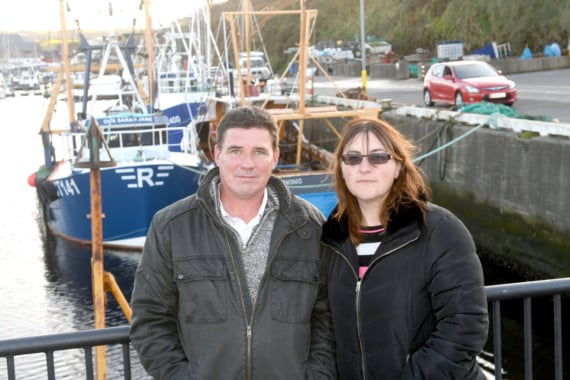
Scallop fishermen have raised concerns about the impact on the fishery of planned oil and gas exploration and windfarm development.
And they claim ’flawed’ surveys suggesting declining stocks have brought the scallop fleet to the brink - and are paving the way for the seismic surveys and gas rigs.
Alex Ironside, 47, has been fishing for scallops and queenies in Manx waters for 32 years, just as his father did before him.
He claims that while fishermen have seen ups and downs in fishing stocks, there has been no decline overall.
-(1).jpeg?width=209&height=140&crop=209:145,smart&quality=75) Fire crews respond to 11 incidents across the Isle of Man in a single day
Fire crews respond to 11 incidents across the Isle of Man in a single day.jpg?width=209&height=140&crop=209:145,smart&quality=75) Police found 41 vapes containing controlled drug hidden under man’s bed
Police found 41 vapes containing controlled drug hidden under man’s bed.png?width=209&height=140&crop=209:145,smart&quality=75) Just 6% of Isle of Man visa applicants required to provide criminal record checks
Just 6% of Isle of Man visa applicants required to provide criminal record checks Met Office give verdict on whether the Isle of Man will have a white Christmas
Mr Ironside said: ’Government has drastically reduced quotas for queenies to protect "diminishing stocks" but now they’re planning to do seismic surveys for gas and oil where the queenies were.
’Why protect them and then wipe them out building gas rigs on them?’
He added: ’We’ve lost thousands and thousands of pounds and we are at breaking point now.’
Total allowable catch for queen scallops was cut by 40% to just 476 tonnes at the beginning of the season in July.
The following month all but one area of the fishery was closed to conserve declining stocks.
Environment Minister Geoffrey Boot warned there is a ’real possibility’ that there would be no queen scallop fishing at all next year.
The fishermen are being invited to apply for grants to diversify into fishing for prawns, squid or white fish.
But fishermen say their licences don’t cover other types of fishing and there is no quota available for white fish or other types of shellfish.
An agreement was reached between the Manx government and energy firm Orsted in 2015 to carry out preliminary investigations for a potential offshore wind farm.
It overlaps the 350 sq/m area, in the north east of the Manx territorial waters, where a licence has been issued to Crogga Ltd for the initial exploration for oil and gas.
Crogga Ltd will shortly be issued with a permit for seismic surveying some time between December this year and April 2020.
DEFA insists that the seismic survey area does not include any of the island’s major scallop fishing grounds, although some low levels of scallop fishing do take place.
A spokesman said: ’The conditions that the government has applied to the exploration permit should minimise the risk of damage to stocks.
’The effects of the surveys will be monitored.
’Current research is inconclusive as to whether seismic surveys damage marine animals.’
But David Beard, chief executive officer of the Manx Fish Producers’ Organisation, said the seismic surveys were of ’great concern’ to the Manx fishing industry.
He said there is ’no doubt’ there are fishable quantities of both king and queen scallops in the south and south west of the area where seismic surveys are to be carried out.
He said: ’It is uncertain as to what effect seismic surveys have on commercial species such as king scallop, queen scallops, whelk and lobster.
’There have been anecdotal evidence of mortalities amongst scallop stocks caused by seismic surveys and scientific studies have noted that seismic surveys can cause major issues with these species.’
’I really hope it has no effect,’ he said.
Mr Beard said the real concern was that the surveys will be carried out in water depths of 10-40m, whereas most other seismic surveys are carried out in much deeper water.
He said there were also concerns that the development of the wind farm will be through pile driven structures.
Sound waves resulting from months or years of construction work will have an effect on commercial fish stocks and marine mammals and this is a key area for herring spawning, he claimed.
DEFA said that Orsted and Crogga will require appropriate consents at each stage.
Manx Wildlife Trust is also concerned about the impact of seismic surveys - and not just because of the fisheries in the area.
The trust’s marine officer Lara Howe said: ’We just don’t know how much of an impact it may have.
’Some evidence suggests it can have impacts on the larvae and juvenile scallops but nothing conclusive.’
For the past five years the Manx government has been paying Bangor University to carry out surveys of scallop stocks.
The fishermen believe the surveys are flawed as the queenies move each year but the survey always takes place over the same sites.
Bangor’s surveys have led to continuing cuts in quotas.
Mr Beard said: ’There is no doubt that the Manx fleet are angry and desperate at the moment.
’Angry because they feel that there are far more queen scallops in Manx waters than the Bangor survey indicated and desperate because the quotas for both queen and king scallop are being continually cut.’
A more detailed, higher resolution, survey of adult and juvenile scallop stocks was carried out in the summer by the Manx Fish Producers’ Organisation. The survey was designed, and its results assessed, by Bangor University.
It found hot spots of high density of scallop population on the island’s east coast.
It also suggests a number of areas around the island that had good levels of juveniles.
As a result the cut in quota was raised from 40% to 20%.
Mr Beard said there is a hope that the queen scallop fishery has ’turned a corner’ - but only if the fleet can survive this year’s greatly reduced income levels.
Meanwhile, Mr Ironside said: ’They’re saying there aren’t any queenies there but the fishermen know there is and so do the government.’
He said some fishermen suspect the government’s motives.
They believe claims of there being no queenies in areas where seismic surveys will be carried out will mean no compensation will be paid when they lose the fishing grounds to drilling.
Comments
This article has no comments yet. Be the first to leave a comment.